Skip linksSkip to Content
play
Live
Navigation menu
  • News
    • Africa
    • Asia
    • US & Canada
    • Latin America
    • Europe
    • Asia Pacific
  • Middle East
  • Explained
  • Opinion
  • Sport
  • Video
    • Features
    • Economy
    • Human Rights
    • Climate Crisis
    • Investigations
    • Interactives
    • In Pictures
    • Science & Technology
    • Podcasts
    • Travel
play
Live

In Pictures

Gallery

In Pictures: Saffron blooms in Kashmir

Pampore in Indian-administered Kashmir is living up to its reputation as “Saffron Town” as harvesting season arrives.
Save

Share

facebooktwitterwhatsappcopylink
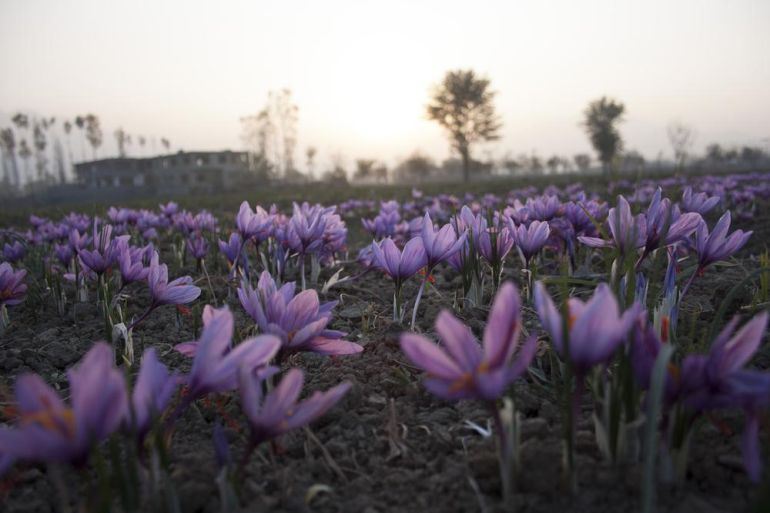
Harvesting of saffron commences in the last week of October and continues for five to six weeks in Kashmir.
By Aarabu Ahmad Sultan
Published On 29 Nov 201329 Nov 2013

Colour is virtually running riot in Pampore, an otherwise nondescript town in the Indian-adminstered region of Jammu and Kashmir, as millions of saffron flowers bloom.

India is among the world’s four biggest producers of saffron – a spice used in cuisine all over the world – and Kashmir is India’s prime producer. And within Kashmir, Pampore accounts for 80 percent of the produce.

And this autumn – with arrival of saffron harvesting season – Pampore is once again living up to its reputation as the ‘Saffron Town’.

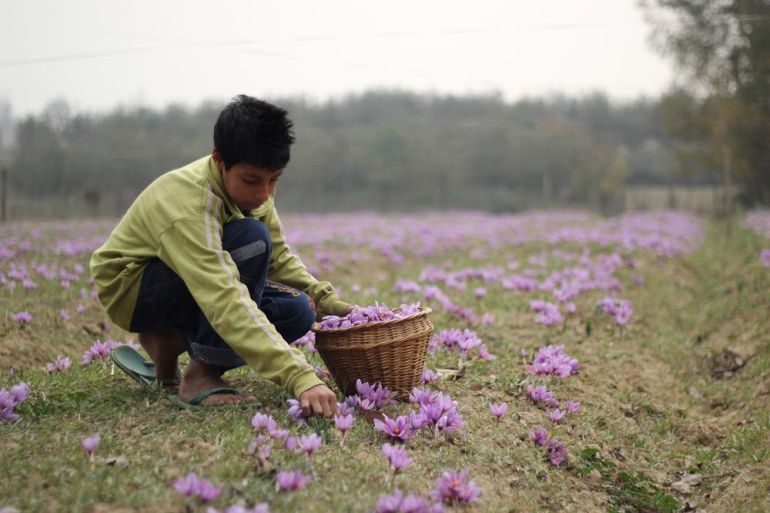
Hundreds of men, women and children have descended on its undulating plains to pluck the saffron flowers, carpeting the floor.

Iran far outstrips India in saffron production. But Kashmiri saffron is known to have the edge when it comes to aroma, making it the costliest. 

‘Red Gold’ as it is called, the cultivation of saffron is a lifeline for thousands in the troubled region rocked by two decades of insurgency. A good harvest is what they are all looking for, and there is a feel of festivity in the air as saffron is harvested, for processing and its onward journey to ultimately spice up palates.

Saffron is considered the world’s costliest spice.
Advertisement
Saffron is famous for its aroma, medicinal, dyeing and cosmetic purposes.
It is an annual crop and growers have to put lot of effort, as all the work is done manually, from sowing the saffron corm to its harvest.
In the Kashmir valley, it is mostly grown in the districts of Pulwama and Budgam.
(***)Saffron town(***) Pampore accounts for 80 percent of saffron grown in Kashmir.
Harvesting time is like a festival during which women sing folk songs and the elderly narrate folk tales to children.
Advertisement
At the time of harvest growers usually take the help of their relatives and friends to pluck the saffron flowers.
Growers leave homes late morning, after the dew fades away from the flowers, and start plucking the saffron flowers.
Children are the most enthusiastic about the harvest of saffron, as they get lot gifts for helping out.
Velvet of saffron flowers laid on the earth is a feast for honey bees, whose buzzing is music to ears for people who pluck flowers.
After plucking the flowers from the field, families sit together after sunset and start separating the stigma (saffron) from the flower by hand.
Between 130 and 160 flowers constitute 1 gram of saffron after drying.
Saffron harvesting season is also a reason for tourist flow to the valley during autumn season.
When dark red stigma, saffron, is separated from the flower it is then left to dry inside a room, not directly facing the sun which fades its colour.
Growers usually sell dried saffron to brokers who then sell it to firms.
Firms then produce the costliest and finest quality type of saffron known as Mongra or Mogra from it.
There are three types of saffron: Mongra, the costliest and finest one; Lacha, the second costliest and purest one; and the third type is Zarda, the tail part which is cheapest.
Saffron is a major source of income for growers.
Kashmiri saffron has a traditional and cultural identity associated with it, as it is used in the most famous cuisine of Kashmir, Waazwan, and the exotic beverage Kehwa that is served to guests at the time of marriage.
Each part of the saffron flower is useful. The stigma part is the saffron, the yellow coloured part is used for colouring purposes, and petals are used as vegetables and also for antiseptic purposes.

More from Gallery

  • Photos: Manila’s streets empty as fuel prices surge amid Hormuz crisis

    A sharp increase in prices of basic commodities and the possible loss of employment for thousands of people due to the fuel price hike have raised the spectre of stagflation in the Philippines.
    This gallery article has 10 imagescamera10
  • Photos: More than one million displaced by Israel’s evacuations in Lebanon

    Over one million displaced by Israel’s evacuations in Lebanon
    This gallery article has 10 imagescamera10
  • Migrants march in southern Mexico to denounce immigration restrictions

    Migrants, some carrying children, walk on the highway through the municipality of Huehuetan, Chiapas state, Mexico, Wednesday, March 25, 2026, after leaving Tapachula the previous night. (AP Photo/Edgar H. Clemente)
    This gallery article has 9 imagescamera9
  • Photos: Iran fires new waves of missiles at Israel

    This picture shows damaged buildings at the site of an Iranian missile strike in Tel Aviv
    This gallery article has 8 imagescamera8

Most popular

  • Tehran vows to extract ‘heavy price’ for Israeli hits on two nuclear sites

    TOPSHOT - This video grab taken from images released by the Iranian state broadcaster (IRIB) on March 26, 2026, shows what it says is the second phase of the 82nd wave of missiles launched against Israel and US bases in the United Arab Emirates and Kuwait.
  • US diplomat Marco Rubio denounces settler violence, tolls in Hormuz strait

    US Secretary of State Marco Rubio looks on as he speaks to the press before his departure following a G7 Foreign Ministers' meeting with Partner Countries before his departure at the Bourget airport in Le Bourget, outside Paris, France, March 27, 2026. Brendan Smialowski/Pool via REUTERS
  • How extensive is Russia’s military aid to Iran?

    Iranian missile strikes
  • Israel launches strikes on nuclear sites as Iran warns of retaliation

    People gather near a damaged car at the site of a residential building damaged by a strike, amid the U.S.-Israeli conflict with Iran, in Tehran, Iran, March 27, 2026. Majid Asgaripour/WANA (West Asia News Agency) via REUTERS ATTENTION EDITORS - THIS PICTURE WAS PROVIDED BY A THIRD PARTY

  • About

    • About Us
    • Code of Ethics
    • Terms and Conditions
    • EU/EEA Regulatory Notice
    • Privacy Policy
    • Cookie Policy
    • Cookie Preferences
    • Accessibility Statement
    • Sitemap
    • Work for us
  • Connect

    • Contact Us
    • User Accounts Help
    • Advertise with us
    • Stay Connected
    • Newsletters
    • Channel Finder
    • TV Schedule
    • Podcasts
    • Submit a Tip
    • Paid Partner Content
  • Our Channels

    • Al Jazeera Arabic
    • Al Jazeera English
    • Al Jazeera Investigative Unit
    • Al Jazeera Mubasher
    • Al Jazeera Documentary
    • Al Jazeera Balkans
    • AJ+
  • Our Network

    • Al Jazeera Centre for Studies
    • Al Jazeera Media Institute
    • Learn Arabic
    • Al Jazeera Centre for Public Liberties & Human Rights
    • Al Jazeera Forum
    • Al Jazeera Hotel Partners

Follow Al Jazeera English:

  • facebook
  • twitter
  • youtube
  • instagram-colored-outline
  • rss
Al Jazeera Media Network logo
© 2026 Al Jazeera Media Network