Skip linksSkip to Content
play
Live
Navigation menu
  • News
    • Africa
    • Asia
    • US & Canada
    • Latin America
    • Europe
    • Asia Pacific
  • Middle East
  • Explained
  • Opinion
  • Sport
  • Video
    • Features
    • Economy
    • Human Rights
    • Climate Crisis
    • Investigations
    • Interactives
    • In Pictures
    • Science & Technology
    • Podcasts
    • Travel
play
Live

In Pictures

Gallery

In Pictures: Crackdown in Brazil’s favelas

The Brazilian government’s ‘pacification’ initiative has led to drug busts and shootouts in Rio’s favelas.

Save

Share

facebooktwitterwhatsappcopylink
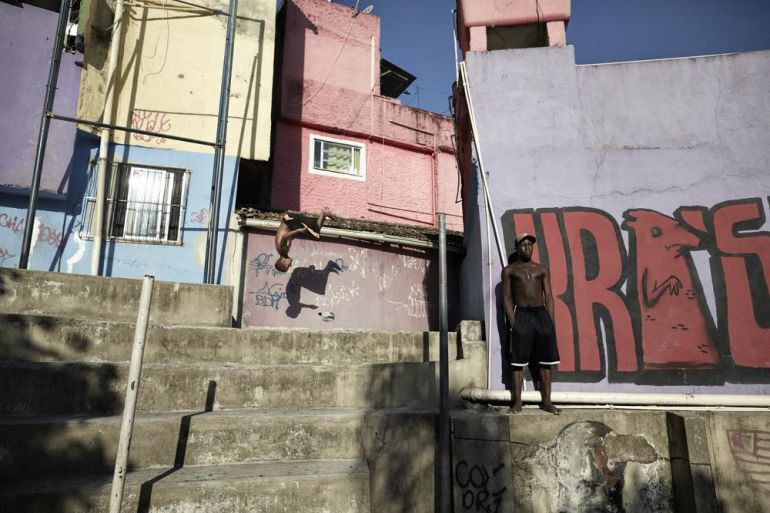
Members of the Pacifying Police Unit (UPP) stand guard while children play on top of the Macaco favela in northern Rio de Janeiro.
By Sebestiano Tomada
Published On 3 Apr 20143 Apr 2014

Just a few months before Rio de Janeiro welcomes visitors for the World Cup, and two years before it hosts the Olympics, security within the city remains a major issue.

The government currently promotes the policy of “pacification”, where security forces engage in raids, drug busts, and even gunfights with suspected gang members. This pacification policy is supposed to pave the way for the development of long-neglected favelas in Rio, Brazil’s second-biggest city and home to 11 million people.

Rio’s government has established the Pacifying Police Unit, a military police team with the intent of establishing security and diminishing criminality with force.

These police units stand at the centre of Rio Governor Sergio Cabral Filho’s security strategy. They have set up permanent stations in the working class areas or favelas in order to conduct routine patrols and to be able to quickly respond to gang activity, such as Comando Vermelho and Amigos dos Amigos (ADA), two large and often violent criminal organisations. There are now approximately 34 Pacifying Police Units in Rio, controlling more than 100 favelas where hundreds of thousands reside. 

However, many of the favelas remain in the hands of an army of drug dealers and criminals who are not willing to step down or be pacified.

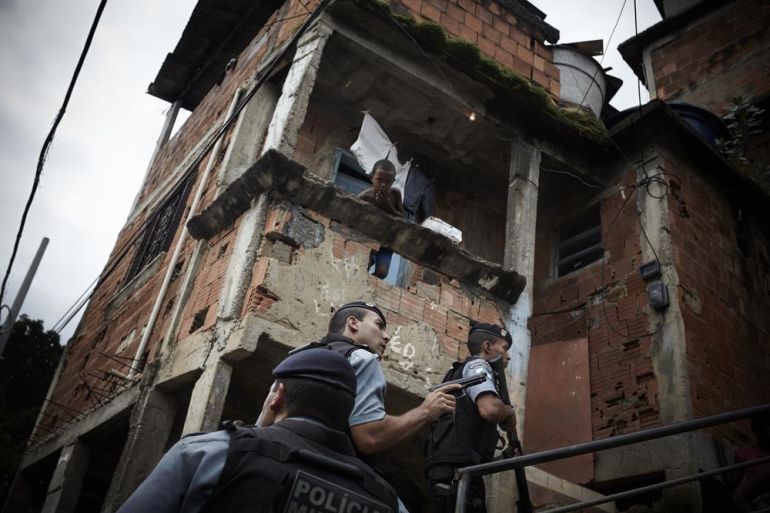
Marx and Chaves, two UPP patrol leaders, talk to locals about criminial activity in the favelas.
Advertisement
While on patrol, each member of the unit is trained to look for suspicious activity and to provide cover for the other members.
A child watches an UPP unit as they patrol a favela.
Patrol leaders Damaso and Marx observe suspicious activity from a distance. UPP aggresively responds to suspected gang activity, which have led to shootouts.
A gang member, also known as a (***)trafficante(***), poses with his weapons in one of the many non-pacified favelas of Rio de Janeiro.
A drug dealer with the ADA gang counts money from a drug transaction. Cocaine and crack are the most popular drugs within the favelas.
Advertisement
Chaves, a member of the police unit, pats down a suspect for drugs. 
UPP members frisk suspected drug dealers and gang members in the Macaco favela.
Members of a family relax outside their home in Rocinha, a favela that(***)s home to the ADA gang.
A desolated street in a favela. UPP operates in favelas that have not paid for public utilities. These favelas instead, give money to the controlling criminal organisations, leading to widespread tax evasion. 
A view of the Rochinha favela - one of the few pacified communities in Rio de Janeiro.

More from Gallery

  • Photos: Manila’s streets empty as fuel prices surge amid Hormuz crisis

    A sharp increase in prices of basic commodities and the possible loss of employment for thousands of people due to the fuel price hike have raised the spectre of stagflation in the Philippines.
    This gallery article has 10 imagescamera10
  • Photos: More than one million displaced by Israel’s evacuations in Lebanon

    Over one million displaced by Israel’s evacuations in Lebanon
    This gallery article has 10 imagescamera10
  • Migrants march in southern Mexico to denounce immigration restrictions

    Migrants, some carrying children, walk on the highway through the municipality of Huehuetan, Chiapas state, Mexico, Wednesday, March 25, 2026, after leaving Tapachula the previous night. (AP Photo/Edgar H. Clemente)
    This gallery article has 9 imagescamera9
  • Photos: Iran fires new waves of missiles at Israel

    This picture shows damaged buildings at the site of an Iranian missile strike in Tel Aviv
    This gallery article has 8 imagescamera8

Most popular

  • ‘Playing with fire’: Iran vows response after civilian nuclear sites struck

    epaselect epa12854185 Rescuers work at a site following an Israeli airstrike that targeted a building in the village of Al Saksakiyah, southern Lebanon, 27 March 2026. According to the Lebanese Ministry of Public Health, at least 1,116 people have been killed and over 3,229 others injured in airstrikes across Beirut's southern suburbs and villages in southern Lebanon since the start of renewed hostilities. EPA/STRINGER
  • US diplomat Marco Rubio denounces settler violence, tolls in Hormuz strait

    US Secretary of State Marco Rubio looks on as he speaks to the press before his departure following a G7 Foreign Ministers' meeting with Partner Countries before his departure at the Bourget airport in Le Bourget, outside Paris, France, March 27, 2026. Brendan Smialowski/Pool via REUTERS
  • Iran war updates: Tehran vows retaliation for Israeli hits on nuclear sites

    TOPSHOT - This video grab taken from images released by the Iranian state broadcaster (IRIB) on March 26, 2026, shows what it says is the second phase of the 82nd wave of missiles launched against Israel and US bases in the United Arab Emirates and Kuwait.
  • Guns in the streets as US, Israel intensify month-long attacks across Iran

    TEHRAN, IRAN - MARCH 27: A resident cleans up debris in a damaged apartment across from another residential building following an airstrike in the early hours of March 27, 2026 in Tehran, Iran. The Israeli military said that it had carried out strikes on targets across Tehran and other Iranian cities overnight. The United States and Israel have continued their joint attack on Iran that began on February 28. Iran retaliated by firing waves of missiles and drones at Israel and U.S. allies in the region, while also effectively blockading the Strait of Hormuz, a critical shipping route. (Photo by Majid Saeedi/Getty Images)

  • About

    • About Us
    • Code of Ethics
    • Terms and Conditions
    • EU/EEA Regulatory Notice
    • Privacy Policy
    • Cookie Policy
    • Cookie Preferences
    • Accessibility Statement
    • Sitemap
    • Work for us
  • Connect

    • Contact Us
    • User Accounts Help
    • Advertise with us
    • Stay Connected
    • Newsletters
    • Channel Finder
    • TV Schedule
    • Podcasts
    • Submit a Tip
    • Paid Partner Content
  • Our Channels

    • Al Jazeera Arabic
    • Al Jazeera English
    • Al Jazeera Investigative Unit
    • Al Jazeera Mubasher
    • Al Jazeera Documentary
    • Al Jazeera Balkans
    • AJ+
  • Our Network

    • Al Jazeera Centre for Studies
    • Al Jazeera Media Institute
    • Learn Arabic
    • Al Jazeera Centre for Public Liberties & Human Rights
    • Al Jazeera Forum
    • Al Jazeera Hotel Partners

Follow Al Jazeera English:

  • facebook
  • twitter
  • youtube
  • instagram-colored-outline
  • rss
Al Jazeera Media Network logo
© 2026 Al Jazeera Media Network