Skip linksSkip to Content
play
Live
Navigation menu
  • News
    • Africa
    • Asia
    • US & Canada
    • Latin America
    • Europe
    • Asia Pacific
  • Middle East
  • Explained
  • Opinion
  • Sport
  • Video
    • Features
    • Economy
    • Human Rights
    • Climate Crisis
    • Investigations
    • Interactives
    • In Pictures
    • Science & Technology
    • Podcasts
    • Travel
play
Live

In Pictures

Gallery

Surviving climate change in Bangladesh

Cyclones, storms, flooding were always a part of life, but now come more often, are less predictable and more powerful.
Save

Share

facebooktwitterwhatsappcopylink
Surviving climate change in Bangladesh
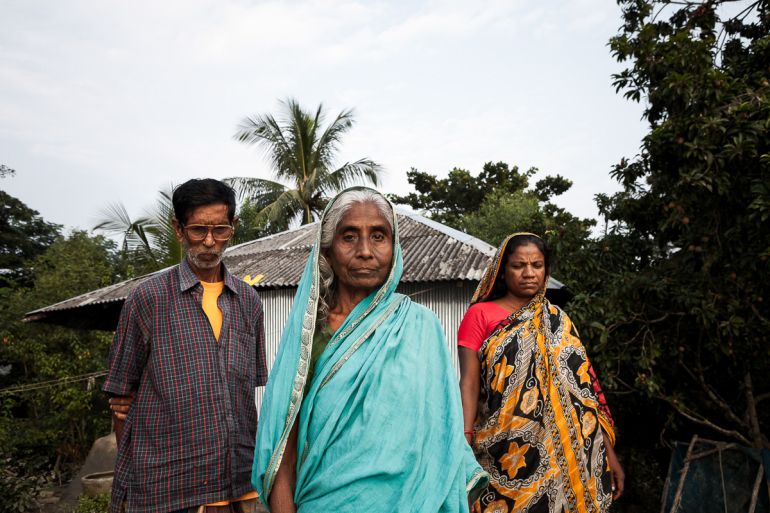
Onil Haldar, Joshna Awdar and Taraja Oditto, are neighbours in the village of Kanainagar in the southern district of Mongal. The house behind them has been rebuilt three times, each time the land, as they say, 'got eaten by the river'. The river has now reached the front door again. [Karim Mostafa/Al Jazeera]
By Jenny Gustafsson and Karim Mostafa
Published On 10 Jul 201610 Jul 2016

Southern Bangladesh, Bangladesh – As one of the world’s most densely populated countries, situated over the large delta where three of Asia’s biggest rivers –  the Ganges, Brahmaputra, and Meghna – meet, Bangladesh feels the effects of a changing climate intensely.

While cyclones, storms and flooding rivers have always been a part of life here, they now seem to come more often, are less predictable and are more powerful. River erosion has increased and the sea levels have risen bringing salty water farther inland. In many places, life as people knew it is no longer the same.

The 150 million inhabitants of Bangladesh adapt, cope and innovate in the face of this change. Many have migrated to the capital Dhaka and other cities further inland, which has caused the population in these cities to swell and living conditions to deteriorate.

Others have gone to work in neighbouring India, Malaysia or countries in the Arabian Gulf.

In Khulna, Mongla and Satkhira, and on the island of Bhola, and other parts of southern Bangladesh, families are adjusting to the challenges natures presents.

They rebuild homes that were taken away by the rivers. They grow rice and vegetables in new ways. They try new methods of small-scale farming, despite the threat salty water brings to their lands. Or they too find no other option but to leave and seek a new life in the city.

Surviving climate change in Bangladesh
The small road that once led through Kanainagar has disappeared under water. Little by little, it crumbled into the river, along with a row of houses that stood on the shore. [Karim Mostafa/Al Jazeera]
Advertisement
Surviving climate change in Bangladesh
Konika Mondol and her son Shoikat live in the last house standing by the river. Their house is about to fall in as well, so they are preparing to move to another piece of land. They feel lucky to have that option, they say, but worry about their future. They will receive no compensation for their lost house and land. [Karim Mostafa/Al Jazeera]
Surviving climate change in Bangladesh
A house in rural Satkhira, in the south of Bangladesh. In the past years, people have begun adapting their homes to the changing climate. Schools have been raised off the ground to double as shelters in case of flooding and families have secured their roofs with ropes tied to the ground. [Karim Mostafa/Al Jazeera]
Surviving climate change in Bangladesh
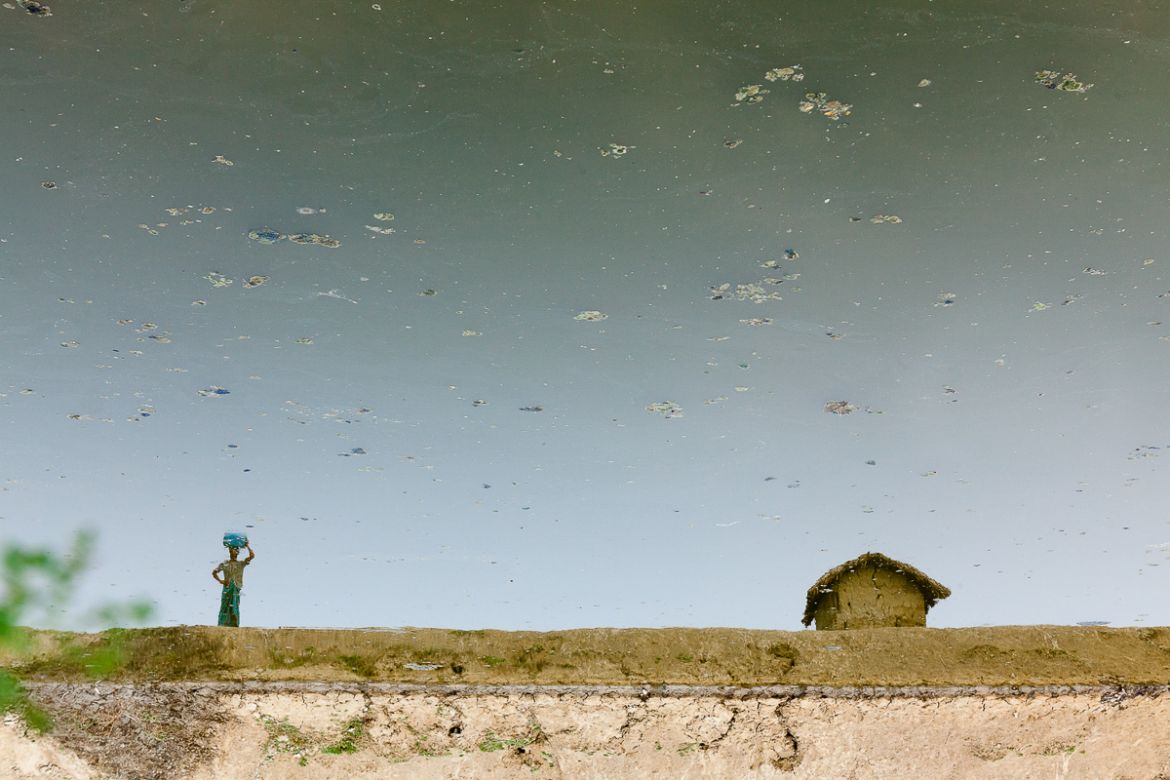
The reflection of a man walking near the water in the Monga region in southern Bangladesh. Despite being one of the countries most affected by climate change, Bangladesh contributes very little to the process. It emits on average 0,4 tonnes of carbon dioxide per person each year, compared with 7,5 tonnes per person in Europe, 6 tonnes in the Middle East and a world average of 4,9 tonnes, according to World Bank. [Karim Mostafa/Al Jazeera]
Surviving climate change in Bangladesh
A girl runs across submerged lands in front of her house near the river outside Mongla. One of the biggest impacts for families in southern Bangladesh is the increasing salinity of the water. What was previously fertile farmland is now unfit for growing food, and water that was once fit for drinking has become salty. [Karim Mostafa/Al Jazeera]
Surviving climate change in Bangladesh
A mother feeding her baby in a village outside of Shyamnagar, in the Satkhira region. The village was established by a group of families who all lost their homes in the 2009 Cyclone Aila, which displaced more than a million people. Now, with the support of a local NGO, they do small-scale farming using natural methods. [Karim Mostafa/Al Jazeera]
Advertisement
Surviving climate change in Bangladesh
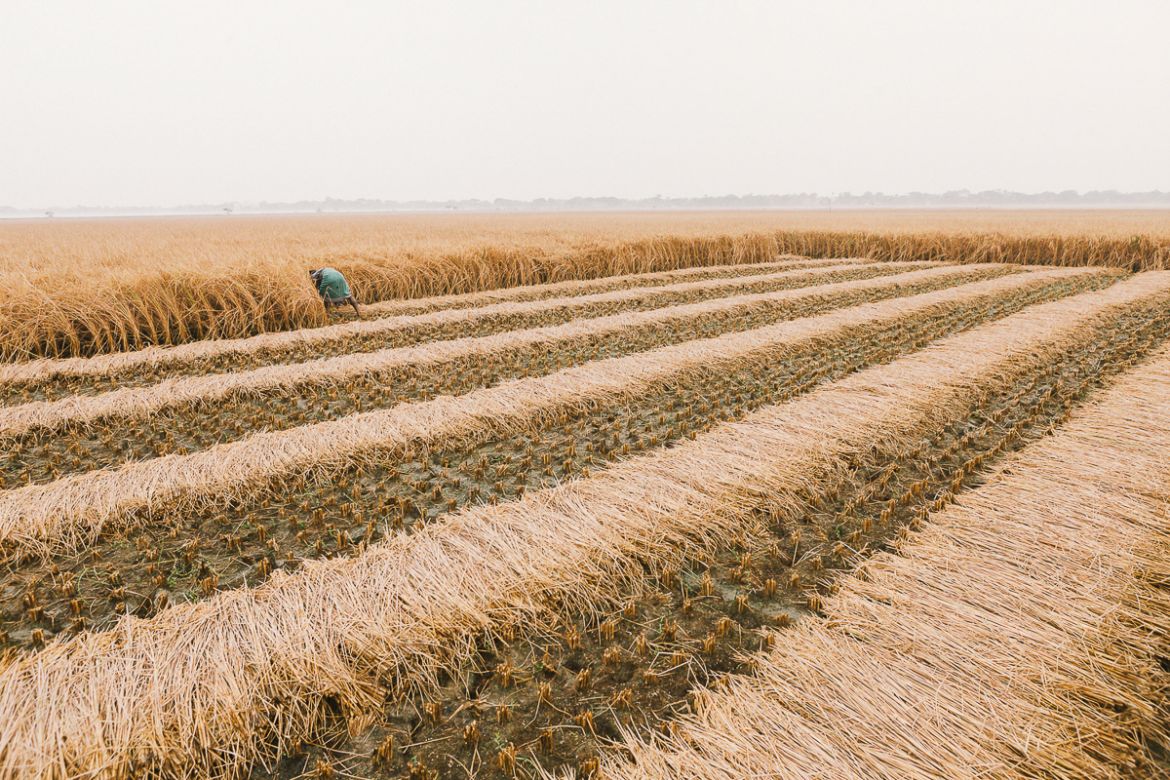
Early morning in the rice fields outside of Mongla. With the increasing salinity in the water, growing rice is becoming more difficult. [Karim Mostafa/Al Jazeera]
Surviving climate change in Bangladesh
A man harvests rice one early morning in Shyamnagar, in the southern part of Satkhira. As conventional rice has become difficult to grow in salt-affected areas, new kinds of rice have been developed. 'Scuba rice' tolerates high levels of salinity and can survive being submerged for periods of time. Still, the challenge is finding rice with the right flavour. [Karim Mostafa/Al Jazeera]
Surviving climate change in Bangladesh
Fish and shrimp at the market in Mongla. Large pieces of farmland in southern Bangladesh have been converted into ponds for cultivating giant shrimp for export. But little money reaches the local communities, who face fewer job opportunities and a grey, degraded environment as a result. [Karim Mostafa/Al Jazeera]
Onjo Boiragi, catching crabs nearby her home in a village outside Mongla. many parts of the region, the land surrounding her house has growing more and more salty, making traditional rice cultiva
Onjo Boiragi, goes in search of crabs near her home in a village outside Mongla. Like many parts of the region, the land surrounding her house has growing salty, making traditional rice cultivation harder. [Karim Mostafa/Al Jazeera]
Surviving climate change in Bangladesh
The island of Bhola, often called 'the Ground Zero of climate change', is an extremely low-lying island that is slowly disappearing due to rising sea levels and river erosion. Families have been leaving Bhola as their lands have disappeared into the water. [Karim Mostafa/Al Jazeera]
Surviving climate change in Bangladesh
Pupils study in a religious school in the town of Charfasson, on Bhola, where many children come from a nearby orphanage. Bhola has been hit by several deadly hurricanes and cyclones, leaving many children without parents. [Karim Mostafa/Al Jazeera]
Surviving climate change in Bangladesh
The large slum area of Bhola Bosti, in the northern part of Dhaka, was established 40 years ago by families who fled the island of Bhola after losing their lands. About 600 families live in Bhola Bosti today, and new people continue to arrive, mostly from the island. [Karim Mostafa/Al Jazeera]
The large slum area of Bhola Bosti in the northern part of Dhaka. It was established 40 years ago by families who fled the island of Bhola after having lost their lands. Around 600 families live in Bh
Shahbuddin Mondol is from Gaibandham, in northern Bangladesh, another area affected by river erosion. He lost his home several times before deciding to leave for work in Dhaka. He sleeps on a roof with 50 other rickshaw drivers. 'My wife and children live with her parents now. She told me, "Go well and come back well. Earn lots of money and return soon!''' [Karim Mostafa/Al Jazeera]

More from Gallery

  • Photos: Manila’s streets empty as fuel prices surge amid Hormuz crisis

    A sharp increase in prices of basic commodities and the possible loss of employment for thousands of people due to the fuel price hike have raised the spectre of stagflation in the Philippines.
    This gallery article has 10 imagescamera10
  • Photos: More than one million displaced by Israel’s evacuations in Lebanon

    Over one million displaced by Israel’s evacuations in Lebanon
    This gallery article has 10 imagescamera10
  • Migrants march in southern Mexico to denounce immigration restrictions

    Migrants, some carrying children, walk on the highway through the municipality of Huehuetan, Chiapas state, Mexico, Wednesday, March 25, 2026, after leaving Tapachula the previous night. (AP Photo/Edgar H. Clemente)
    This gallery article has 9 imagescamera9
  • Photos: Iran fires new waves of missiles at Israel

    This picture shows damaged buildings at the site of an Iranian missile strike in Tel Aviv
    This gallery article has 8 imagescamera8

Most popular

  • Israel vows no let-up in Iran attacks despite US push to end war

    TOPSHOT - This video grab taken from images released by the Iranian state broadcaster (IRIB) on March 26, 2026, shows what it says is the second phase of the 82nd wave of missiles launched against Israel and US bases in the United Arab Emirates and Kuwait.
  • How extensive is Russia’s military aid to Iran?

    Iranian missile strikes
  • Saudi, UAE, Iraq: Can three pipelines help oil escape Strait of Hormuz?

    TOPSHOT - Indian vessel 'Nanda Devi' carrying liquefied petroleum gas (LPG) arrives at Vadinar Port in the Jamnagar district of Gujarat state on March 17, 2026 after Iran allowed it to pass through the Strait of Hormuz, a key energy corridor that remains disrupted by the Middle East war.
  • ‘Raising 10 red flags’: Is Israel’s army exhausted?

    Israeli soldiers

  • About

    • About Us
    • Code of Ethics
    • Terms and Conditions
    • EU/EEA Regulatory Notice
    • Privacy Policy
    • Cookie Policy
    • Cookie Preferences
    • Accessibility Statement
    • Sitemap
    • Work for us
  • Connect

    • Contact Us
    • User Accounts Help
    • Advertise with us
    • Stay Connected
    • Newsletters
    • Channel Finder
    • TV Schedule
    • Podcasts
    • Submit a Tip
    • Paid Partner Content
  • Our Channels

    • Al Jazeera Arabic
    • Al Jazeera English
    • Al Jazeera Investigative Unit
    • Al Jazeera Mubasher
    • Al Jazeera Documentary
    • Al Jazeera Balkans
    • AJ+
  • Our Network

    • Al Jazeera Centre for Studies
    • Al Jazeera Media Institute
    • Learn Arabic
    • Al Jazeera Centre for Public Liberties & Human Rights
    • Al Jazeera Forum
    • Al Jazeera Hotel Partners

Follow Al Jazeera English:

  • facebook
  • twitter
  • youtube
  • instagram-colored-outline
  • rss
Al Jazeera Media Network logo
© 2026 Al Jazeera Media Network