Skip linksSkip to Content
play
Live
Navigation menu
  • News
    • Africa
    • Asia
    • US & Canada
    • Latin America
    • Europe
    • Asia Pacific
  • Middle East
  • Explained
  • Opinion
  • Sport
  • Video
    • Features
    • Economy
    • Human Rights
    • Climate Crisis
    • Investigations
    • Interactives
    • In Pictures
    • Science & Technology
    • Podcasts
    • Travel
play
Live

In Pictures

Gallery|Rohingya

Rohingya: Chased from Myanmar, unwelcome in Bangladesh

‘I grabbed my children and ran towards the forest, and waited there with several hundred people.’
Save

Share

facebooktwitterwhatsappcopylink
Rohingya in Bangladesh / Please Do Not Use
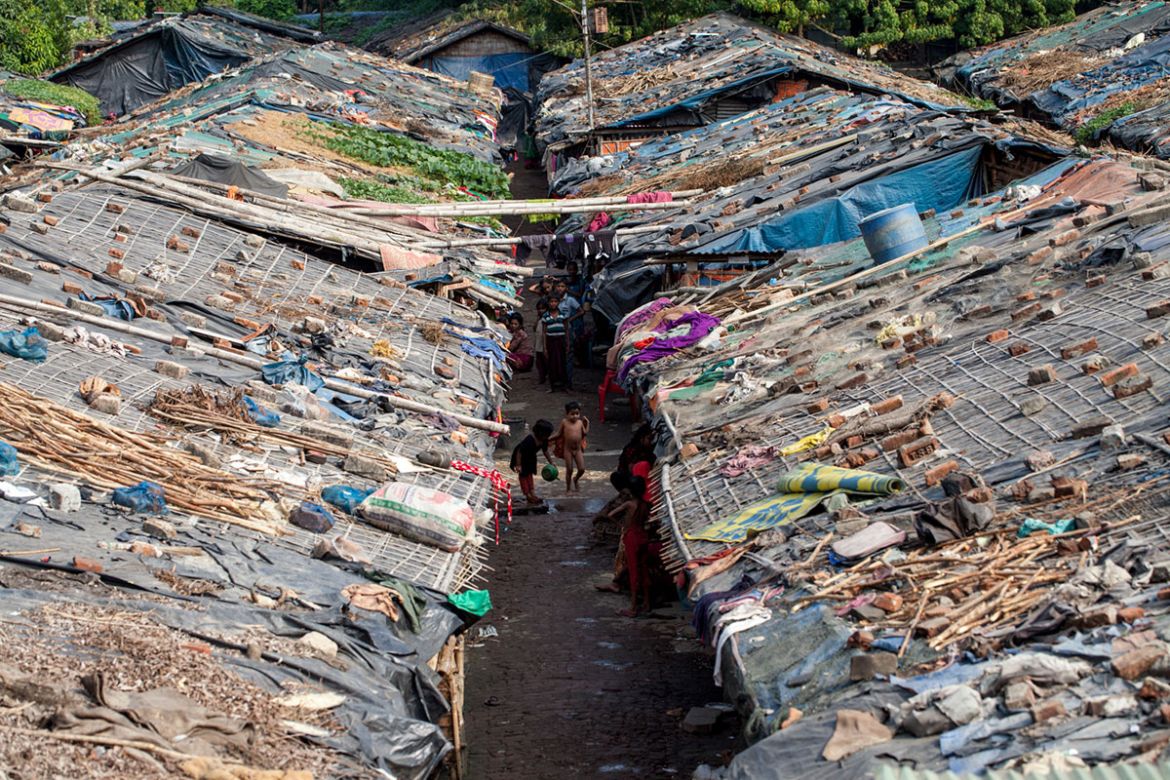
Conditions are dire inside the Leda Rohingya refugee camp in Teknaf, Cox's Bazar. [Mahmud Hossain Opu/Al Jazeera]
By Mahmud Hossain Opu
Published On 1 Feb 20171 Feb 2017

Cox’s Bazar, Bangladesh – Ambia Khatun grabbed her two children and dashed out of her burning house on the early morning of November 23 last year. A teary-eyed Khatun said her husband could not make out of the house as the army started firing.

Thirty-seven-year-old Khatun is from Kearipara village in western Myanmar’s Maungdaw town. She says she fled along with other Rohingya families, leaving behind her husband’s body, as rows of houses were set on fire by the army.

Along with 2,500 Rohingya families, she has taken refuge at a makeshift camp in Leda at eastern Bangladesh’s Cox’s Bazar near the border with Myanmar.

“I grabbed my children and ran towards the forest and waited there with several hundred people,” she told Al Jazeera at her camp in Leda village.

World Food Programme and other local NGOs have come forward to provide food and emergency medical aid, as Bangladesh has refused to register Rohingya Muslims as refugees.

Nearly 65,000 Rohingya Muslims have fled to neighbouring Bangladesh since October when the army launched a crackdown against the Muslim minority after a deadly attack on a military post.

Myanmar says it is acting against perpetrators of the attack, but rights group say the military has been running a systematic campaign of violence against Rohingya in western Rakhine state.

A traumatised Khatun says she never imagined that her family could be ruined in this way.

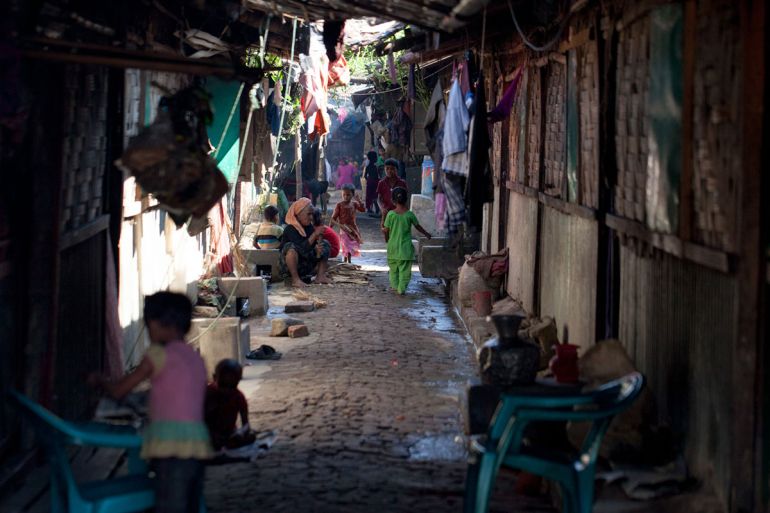
The camp at Leda looks cramped. The facility is squalid and lacks basic amenities. Children roam around the narrow rows of tin and bamboo huts. They lack access to education, medical care and sanitation.

Advertisement

Ziaur Rahman, a Rohingya rickshaw puller, said many people living in the camps have no money to spend. Rahman, who has been living in the area for the last 15 years, told Al Jazeera he chipped in with some money to help them survive.

Some Rohingya Muslims, who have money, rent space in nearby houses and some are building new houses, he said.

Rohingya in Bangladesh / Please Do Not Use
Fatema Khatun, 55, a Rohingya refugee woman cries as she describes the situation back in her village in Myanmar, where many have died at the hands of government soldiers. [Mahmud Hossain Opu/Al Jazeera]
Advertisement
Rohingya in Bangladesh / Please Do Not Use
Toiyaba, 30, arrived at Leda refugee camp with her three children, barely escaping with their lives. [Mahmud Hossain Opu/Al Jazeera]
Rohingya in Bangladesh / Please Do Not Use
Thirteen members of this Rohingya family live cramped in a small room at Leda camp. [Mahmud Hossain Opu/Al Jazeera]
Rohingya in Bangladesh / Please Do Not Use
Nurun Nahar, 60, and her four daughters fled after her house was attacked by the army. [Mahmud Hossain Opu/Al Jazeera]
Rohingya in Bangladesh / Please Do Not Use
Nur Fatema, 60, shows the bruises on her arm she says were caused by Myanmar soldiers beating her. [Mahmud Hossain Opu/Al Jazeera]
Rohingya in Bangladesh / Please Do Not Use
Amir Hossain, 40, fled Myanmar along with his seven children for safety in Bangladesh. But, they are left in limbo as the Bangladesh government does not recognise them as refugees. [Mahmud Hossain Opu/Al Jazeera]
Advertisement
Rohingya in Bangladesh / Please Do Not Use
Yesmin, right, 14, poses for a photograph with her family members who were forced to flee Myanmar. Rights group say the military has been running a systematic campaign of violence against Rohingya in western Rakhine state. [Mahmud Hossain Opu/Al Jazeera]
Rohingya in Bangladesh / Please Do Not Use
Rohingya woman runs a shop at the Rohingya refugee camp at Leda. [Mahmud Hossain Opu/Al Jazeera]
Rohingya in Bangladesh / Please Do Not Use
Local religious schools have opened their doors to Rohingya children to continue their studies. [Mahmud Hossain Opu/Al Jazeera]
Rohingya in Bangladesh / Please Do Not Use
The camp at Leda looks cramped. The facility is squalid and lacks basic amenities. Children roam around the narrow rows of tin and bamboo huts. They lack access to education, medical care and sanitation. [Mahmud Hossain Opu/Al Jazeera]
Rohingya in Bangladesh / Please Do Not Use
'The military killed my husband and torched our home. I fled in a jungle along with my two children. After trying for three days, I managed to reach here. I don't want to recall the horrors,' said Sitara Begum, 21, at Leda camp. [Mahmud Hossain Opu/Al Jazeera]
Rohingya in Bangladesh / Please Do Not Use
A Rohingya woman places her jar in a queue to collect water at the Leda Rohingya refugee camp in Bangladesh. [Mahmud Hossain Opu/Al Jazeera]
Rohingya in Bangladesh / Please Do Not Use
Mohammad Rafiq, 24, holds his eight-month-old baby. His wife was killed in one of the attacks. [Mahmud Hossain Opu/Al Jazeera]
Rohingya in Bangladesh / Please Do Not Use
Bangladesh Border Guard soldiers keep a watch for Rohingya refugees on the Naf River, that runs along Myanmar-Bangladesh border from where they enter the country illegally. [Mahmud Hossain Opu/Al Jazeera]

Related

  • 22,000 Rohingya ‘flee Myanmar to Bangladesh’ in a week

    UN says at least 65,000 have escaped since the launch of an army crackdown in Myanmar’s Rakhine state three months ago.

    Published On 9 Jan 20179 Jan 2017
    Situation after deadly attacks and unrest in western Myanmar
  • Malaysia: Muslim countries should end Rohingya crisis

    Malaysia PM Najib Razak warns that Rohingya could be ‘infiltrated’ by ISIL if their plight is not solved.

    Published On 19 Jan 201719 Jan 2017
    The Council of Foreign Ministers of the Organization Of Islamic Cooperation hold meeting on Rohingya

More from Gallery

  • Photos: Manila’s streets empty as fuel prices surge amid Hormuz crisis

    A sharp increase in prices of basic commodities and the possible loss of employment for thousands of people due to the fuel price hike have raised the spectre of stagflation in the Philippines.
    This gallery article has 10 imagescamera10
  • Photos: More than one million displaced by Israel’s evacuations in Lebanon

    Over one million displaced by Israel’s evacuations in Lebanon
    This gallery article has 10 imagescamera10
  • Migrants march in southern Mexico to denounce immigration restrictions

    Migrants, some carrying children, walk on the highway through the municipality of Huehuetan, Chiapas state, Mexico, Wednesday, March 25, 2026, after leaving Tapachula the previous night. (AP Photo/Edgar H. Clemente)
    This gallery article has 9 imagescamera9
  • Photos: Iran fires new waves of missiles at Israel

    This picture shows damaged buildings at the site of an Iranian missile strike in Tel Aviv
    This gallery article has 8 imagescamera8

Most popular

  • Iran targets Saudi capital, hits Kuwait port as Middle East tensions surge

    TOPSHOT - This video grab taken from images released by the Iranian state broadcaster (IRIB) on March 26, 2026, shows what it says is the second phase of the 82nd wave of missiles launched against Israel and US bases in the United Arab Emirates and Kuwait.
  • How extensive is Russia’s military aid to Iran?

    Iranian missile strikes
  • US-Israel war on Iran: What’s happening on day 28 of attacks?

    Protesters attend a rally.
  • Iran war updates: US, Israel attack ignites worst trade rupture in 80 years

    This handout image taken by the European Space Agency (ESA) captured by the Copernicus Sentinel-2 satellite shows a view of smoke plumes billowing in the vicinity Kuwait International Airport on March 25, 2026.

  • About

    • About Us
    • Code of Ethics
    • Terms and Conditions
    • EU/EEA Regulatory Notice
    • Privacy Policy
    • Cookie Policy
    • Cookie Preferences
    • Accessibility Statement
    • Sitemap
    • Work for us
  • Connect

    • Contact Us
    • User Accounts Help
    • Advertise with us
    • Stay Connected
    • Newsletters
    • Channel Finder
    • TV Schedule
    • Podcasts
    • Submit a Tip
    • Paid Partner Content
  • Our Channels

    • Al Jazeera Arabic
    • Al Jazeera English
    • Al Jazeera Investigative Unit
    • Al Jazeera Mubasher
    • Al Jazeera Documentary
    • Al Jazeera Balkans
    • AJ+
  • Our Network

    • Al Jazeera Centre for Studies
    • Al Jazeera Media Institute
    • Learn Arabic
    • Al Jazeera Centre for Public Liberties & Human Rights
    • Al Jazeera Forum
    • Al Jazeera Hotel Partners

Follow Al Jazeera English:

  • facebook
  • twitter
  • youtube
  • instagram-colored-outline
  • rss
Al Jazeera Media Network logo
© 2026 Al Jazeera Media Network