Skip linksSkip to Content
play
Live
Navigation menu
  • News
    • Africa
    • Asia
    • US & Canada
    • Latin America
    • Europe
    • Asia Pacific
  • Middle East
  • Explained
  • Opinion
  • Sport
  • Video
    • Features
    • Economy
    • Human Rights
    • Climate Crisis
    • Investigations
    • Interactives
    • In Pictures
    • Science & Technology
    • Podcasts
    • Travel
play
Live

In Pictures

Gallery|Space

In Pictures: 50th anniversary of Apollo 13’s dramatic mission

Moon mission launched on April 11, 1970, had to be aborted after one of its oxygen tanks ruptured.
Save

Share

facebooktwitterwhatsappcopylink
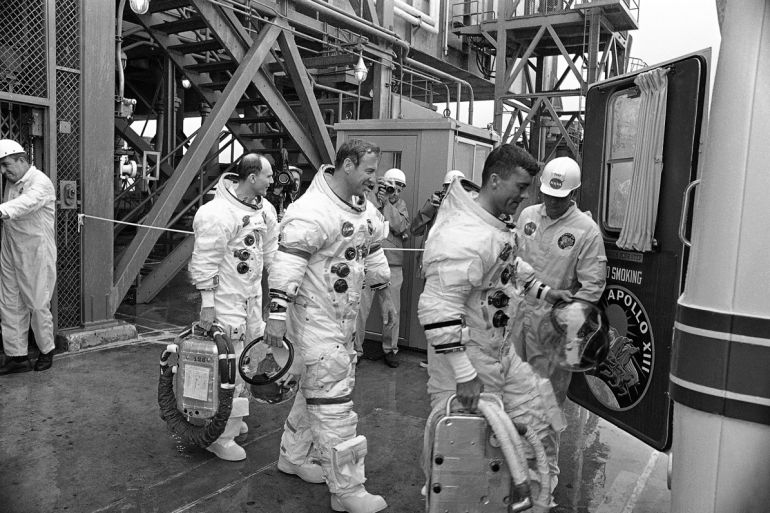
Members of the Apollo 13 crew leave the launch site after finishing a count down demonstration in the Apollo 13 spaceship, March 26, 1970 at Cape Kennedy in Florida. Leading the astronauts is Fred W.
Members of the Apollo 13 crew leave the launch site after finishing a countdown demonstration in the Apollo 13 spacecraft on March 26, 1970 at Cape Kennedy in Florida. Leading the astronauts is Fred W Haise, with command pilot James A Lovell in the middle and Thomas K Mattingly in the back. [AP Photo]
Published On 11 Apr 202011 Apr 2020

Astronauts Jim Lovell, Fred Haise and Jack Swigert boarded the Saturn V rocket on April 11, 1970. They were the crew for the Apollo 13 mission to the moon.

Lovell served as the commander of Apollo 13, Haise the lunar lander pilot and Swigert, a last-minute replacement for another astronaut who had been exposed to German measles, the command module pilot. Lovell and Haise would have been the fifth and sixth men to walk on the moon.

But on April 13, disaster struck.

The astronauts had almost reached the moon when they heard a bang and felt a shudder. One of two oxygen tanks in the service module had ruptured. Within seconds, Houston’s Mission Control saw pressure readings for oxygen tank B plunge to zero.

From that point onwards, the mission was no longer to land on the moon but to make it back to Earth alive. The astronauts were 322,000 kilometres (200,000 miles)from Earth when the explosion happened.

On the ground, flight controllers went into crisis mode, racing to come up with a rescue plan. They immediately ordered the command module Odyssey shut down to conserve what little power remained, and the astronauts into the lunar module Aquarius, now a lifeboat.

Aquarius was designed for two astronauts for two days – all three crew members would need to spend four days inside the module.

The carbon dioxide overload, from breathing, threatened to kill them.

Engineers scrambled to figure out how to convert the square air-purifying canisters in the dead command module into round ones that would fit in the lunar module.

Advertisement

Their outside-the-box, seat-of-the-pants solution, using spacecraft scraps, worked. But it was so damp and cold in the lunar module that the astronauts could not sleep. Condensation covered the walls and windows, and the temperature was close to freezing.

Dehydrated and feverish, Haise had the roughest time during the six-day ordeal, contracting a urinary tract infection.

On April 17, the astronauts managed to power up their condensation-soaked command module, and the spacecraft decelerated into the atmosphere.

Communications were down as the astronauts made their daring re-entry. But finally, three billowing parachutes appeared above the Pacific.

The three men made it safely back to Earth as the world watched what had become a gripping real-life drama.

The tank explosion later was linked to damage caused by electrical overheating in ground tests.

Apollo 13 commander James A. Lovell Jr., is shown during a press conference before the space craft blasted off on its ill-fated journey to the moon, April 11, 1970. With the mission aborted, the astro
Apollo 13 commander Lovell at a news conference before the spacecraft blasted off on its ill-fated journey to the moon. [AP Photo]
Advertisement
FILE - In this April 11, 1970 file photo, the Saturn rocket carrying the Apollo 13 spacecraft lifts off the launch pad at Cape Kennedy, Fla. It really is rocket science and it really is hard. North Ko
The Saturn rocket carrying the Apollo 13 spacecraft lifts off the launch pad at Cape Kennedy on April 11, 1970. [AP Photo]
Astronaut Thomas Stafford, left, and Donald Slayton, Director of Flight Crew Operations, puff on big cigars and applaud as the Apollo 13 made a successful splashdown, April 17, 1970, Houston, Tex. Oth
Astronaut Thomas Stafford, left, and Donald Slayton, director of flight crew operations, puff on big cigars and applaud as the Apollo 13 made a successful splashdown on April 17, 1970, in Houston. [AP Photo]
The time is 1:00 p.m. Est, and all eyes are focused on the television screen in Grand Central Station in New York City, April 17, 1970 watching for the safe landing of the Apollo 13 astronauts in the
The time is 1:00pm EST, and all eyes are focused on the television screen in Grand Central Station in New York city, April 17, 1970, waiting for the safe landing of the Apollo 13 astronauts in the Pacific. [J Spencer Jones/AP Photo]
James A. Lovell III breaks into broad smile as he watches his dad climb out of Apollo 13 command capsule. Young Lovell, 15-year-old cadet at St. John?s Military Academy, watched the space recovery on
James Lovell III breaks into broad smile as he watches his dad climb out of the Apollo 13 command capsule. [Paul Shane/AP Photo]
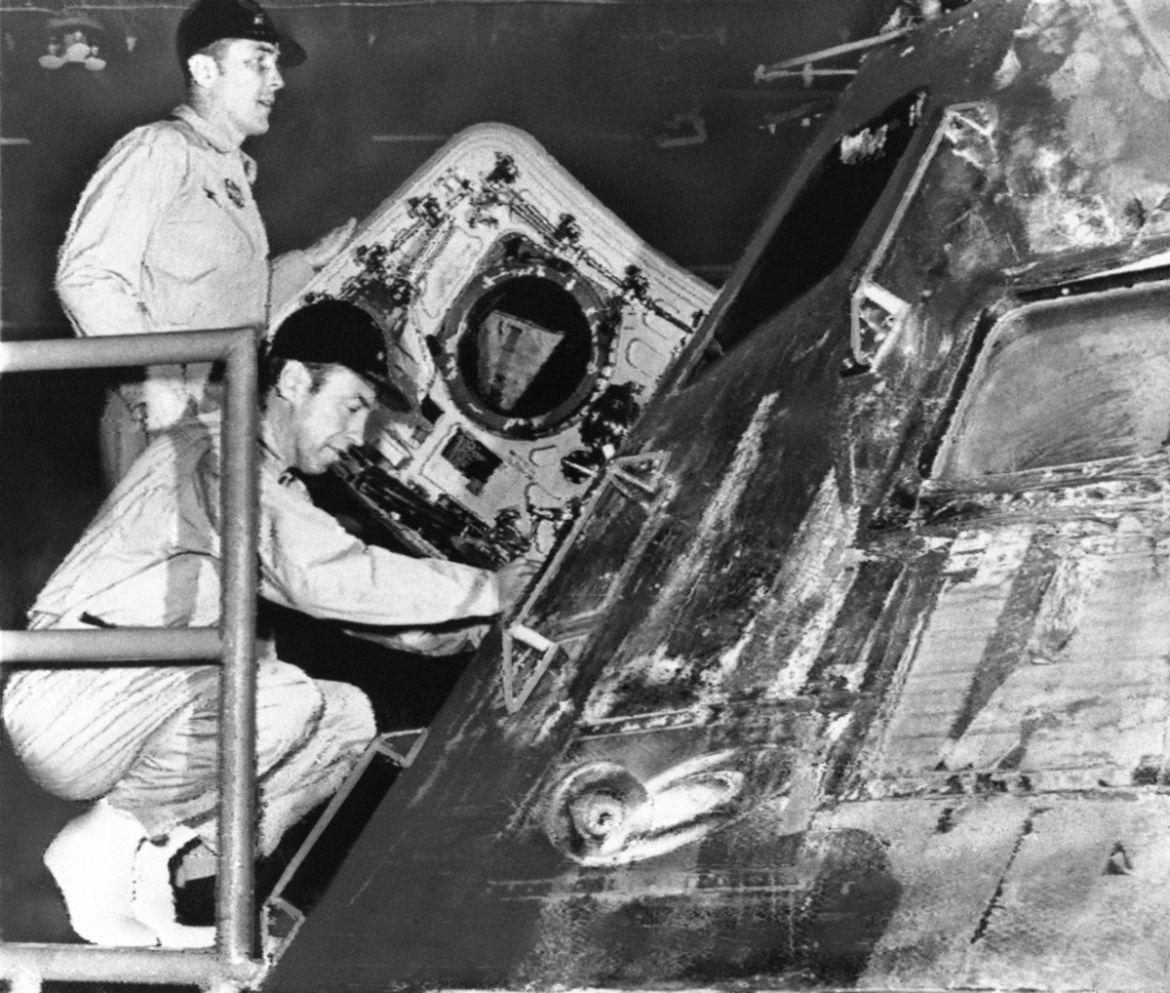
Safely aboard the prime recovery ship, USS Iwo Jima, astronauts James Lovell, squatting, and John Swigert, inspect the Apollo 13 command module that carried them to a safe spl ashdown in the South Pac
Safely on board the prime recovery ship, USS Iwo Jima, astronauts James Lovell, squatting, and John Swigert, inspect the Apollo 13 command module that carried them to a safe splashdown in the South Pacific. [AP Photo]
Advertisement
Apollo 13 commander James A. Lovell Jr., left, opens the astronauts televised news conference at the Manned Spacecraft Center, Houston, Tex., April 21, 1970 by saying ?I?m not a superstitious man? all
Apollo 13 commander James A Lovell Jr, left, opens the astronauts' televised news conference at the Manned Spacecraft Center, Houston, April 21, 1970 by saying: "I'm not a superstitious man," alluding to the number 13 and the trouble that befell the flight. With Lovell are the other crew members, Command Module Pilot John L Swigert, center, and Fred W Haise, Lunar Module Pilot. [AP Photo]

Related

  • NASA to spend $20bn on moon base, nuclear-powered Mars spacecraft

    The agency will increase robotic missions to the Moon and launch a nuclear spacecraft called Space Reactor 1 Freedom.

    Published On 24 Mar 202624 Mar 2026
    This undated photo, provided by NASA, shows a view of the lunar surface from orbit.
  • NASA rules out March launch for manned moon mission over technical issues

    Artemis 2 is a precursor to the US space agency’s planned astronaut moon landing with Artemis III scheduled for 2028.

    Published On 21 Feb 202621 Feb 2026
    A journalist snaps a photo of NASA's Artemis II Space Launch System (SLS) rocket and Orion spacecraft seen in the distance from the Kennedy Space Center in Cape Canaveral, Florida on February 20, 2026.
  • Trump orders Pentagon, federal agencies to release files on UFOs and aliens

    US president’s announcement comes amid a surge of interest following comments on aliens by ex-President Barack Obama.

    Published On 20 Feb 202620 Feb 2026
    An attendee poses an alien doll at the Little A'Le'Inn as an influx of tourists responding to a call to 'storm' Area 51, a secretive U.S. military base believed by UFO enthusiasts to hold government secrets about extra-terrestrials, is expected in Rachel, Nevada, U.S. September 19, 2019. REUTERS/Jim Urquhart
  • Musk merges SpaceX and xAI firms, plans for space-based AI data centres

    Musk says solar powered and space-based data centres are the only way to meet AI’s burgeoning energy demands.

    Published On 3 Feb 20263 Feb 2026
    FILE PHOTO: SpaceX's Starship lifts off during its fifth flight test, in Boca Chica, Texas, U.S., October 13, 2024. REUTERS/Kaylee Greenlee Beal/File Photo

More from Gallery

  • Photos: Manila’s streets empty as fuel prices surge amid Hormuz crisis

    A sharp increase in prices of basic commodities and the possible loss of employment for thousands of people due to the fuel price hike have raised the spectre of stagflation in the Philippines.
    This gallery article has 10 imagescamera10
  • Photos: More than one million displaced by Israel’s evacuations in Lebanon

    Over one million displaced by Israel’s evacuations in Lebanon
    This gallery article has 10 imagescamera10
  • Migrants march in southern Mexico to denounce immigration restrictions

    Migrants, some carrying children, walk on the highway through the municipality of Huehuetan, Chiapas state, Mexico, Wednesday, March 25, 2026, after leaving Tapachula the previous night. (AP Photo/Edgar H. Clemente)
    This gallery article has 9 imagescamera9
  • Photos: Iran fires new waves of missiles at Israel

    This picture shows damaged buildings at the site of an Iranian missile strike in Tel Aviv
    This gallery article has 8 imagescamera8

Most popular

  • Iran targets Saudi capital, hits Kuwait port as Middle East tensions surge

    TOPSHOT - This video grab taken from images released by the Iranian state broadcaster (IRIB) on March 26, 2026, shows what it says is the second phase of the 82nd wave of missiles launched against Israel and US bases in the United Arab Emirates and Kuwait.
  • How extensive is Russia’s military aid to Iran?

    Iranian missile strikes
  • US-Israel war on Iran: What’s happening on day 28 of attacks?

    Protesters attend a rally.
  • Iran war updates: US, Israel attack ignites worst trade rupture in 80 years

    This handout image taken by the European Space Agency (ESA) captured by the Copernicus Sentinel-2 satellite shows a view of smoke plumes billowing in the vicinity Kuwait International Airport on March 25, 2026.

  • About

    • About Us
    • Code of Ethics
    • Terms and Conditions
    • EU/EEA Regulatory Notice
    • Privacy Policy
    • Cookie Policy
    • Cookie Preferences
    • Accessibility Statement
    • Sitemap
    • Work for us
  • Connect

    • Contact Us
    • User Accounts Help
    • Advertise with us
    • Stay Connected
    • Newsletters
    • Channel Finder
    • TV Schedule
    • Podcasts
    • Submit a Tip
    • Paid Partner Content
  • Our Channels

    • Al Jazeera Arabic
    • Al Jazeera English
    • Al Jazeera Investigative Unit
    • Al Jazeera Mubasher
    • Al Jazeera Documentary
    • Al Jazeera Balkans
    • AJ+
  • Our Network

    • Al Jazeera Centre for Studies
    • Al Jazeera Media Institute
    • Learn Arabic
    • Al Jazeera Centre for Public Liberties & Human Rights
    • Al Jazeera Forum
    • Al Jazeera Hotel Partners

Follow Al Jazeera English:

  • facebook
  • twitter
  • youtube
  • instagram-colored-outline
  • rss
Al Jazeera Media Network logo
© 2026 Al Jazeera Media Network