Skip linksSkip to Content
play
Live
Navigation menu
  • News
    • Africa
    • Asia
    • US & Canada
    • Latin America
    • Europe
    • Asia Pacific
  • Middle East
  • Explained
  • Opinion
  • Sport
  • Video
    • Features
    • Economy
    • Human Rights
    • Climate Crisis
    • Investigations
    • Interactives
    • In Pictures
    • Science & Technology
    • Podcasts
    • Travel
play
Live

In Pictures

Gallery|Climate Crisis

‘Saved by coal’: Far from COP26, another reality in India

While getting rid of coal may be possible for some developed nations, it is not so simple for developing countries.
Save

Share

facebooktwitterwhatsappcopylink
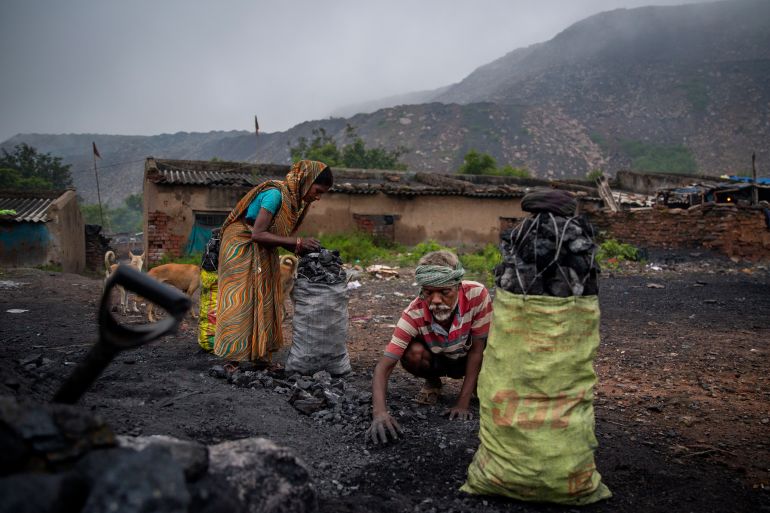
Naresh Chauhan, 50, and his wife Rina Devi, 45, fill sacks with coal in Dhanbad, an eastern Indian city in Jharkhand state. The two have lived in a village at the edge of the Jharia coalfield in Dhanbad all their lives. The couple earn $3 a day selling four baskets of scavenged coal to traders. [Altaf Qadri/AP Photo]
By AP
Published On 1 Nov 20211 Nov 2021

Every day, Raju gets on his bicycle after he straps half a dozen sacks of coal pilfered from mines, up to 200kg (440 pounds), to the reinforced metal frame of his bike.

Driving mostly at night to avoid the police and the heat, he transports the coal 16km (10 miles) to traders who pay him $2.

This has been Raju’s life since he arrived in Dhanbad, a city in India’s eastern state of Jharkhand in 2016.

Thousands of others do the same. Coal is all they have.

This is what the United Nations climate change conference in Scotland, known as COP26, is up against.

Earth desperately needs people to stop burning coal, the biggest single source of greenhouse gases, to avoid the most catastrophic impacts of climate change, including the intense flooding that has cost agricultural jobs in India.

But people rely on coal. It is the world’s biggest source of fuel for electric power and so many, desperate like Raju, depend on it for their very lives.

“The poor have nothing but sorrow … but so many people, they’ve been saved by coal,” Raju said.

Alok Sharma, the United Kingdom’s president-designate of the conference, said in May that he hoped the conference would mark the moment where coal is left “in the past where it belongs”.

While that may be possible for some developed nations, it is not so simple for developing countries. They argue they should be allowed the “carbon space” to grow as developed nations have, by burning cheap fuels like coal, which is used in industrial processes such as steelmaking along with electric power generation.

Advertisement

On average, the typical American uses 12 times more electricity than the typical Indian. There are more than 27 million people in India who do not have electricity at all.

Power demand in India is expected to grow faster than anywhere in the world over the next two decades as the economy grows and ever more extreme heat increases demand for air conditioning that so much the rest of the world takes for granted.

Coal India, the world’s largest miner, aims to increase production to more than one billion tonnes a year by 2024.

“Coal has continued for 100 years. Workers believe it will continue to do so,” said D D Ramanandan, the secretary at the Centre of Indian Trade Unions in Ranchi.

The consequences will be felt both globally and locally. Unless the world drastically cuts greenhouse gas emissions, the planet will suffer even more extreme heat waves, erratic rainfall and destructive storms in coming years, according to the Intergovernmental Panel on Climate Change.

A 2021 study by the Indian government found that Jharkhand, with the nation’s largest coal reserves, is also the most vulnerable Indian state to climate change.

But there are roughly 300,000 people working directly with government-owned coal mines, earning fixed salaries and benefits. And there are nearly four million people in India whose livelihoods are directly or indirectly linked to coal, said Sandeep Pai, who studies energy security and climate change at the Center for Strategic and International Studies in Washington.

India’s coal belt is dotted by industries that need the fuel, like steel and brick making. Indian Railways, one of the country’s largest employers, earns half its revenue by transporting coal, allowing it to subsidise passenger travel.

“Coal is an ecosystem,” Pai said.

An Indian worker smiles as she takes a break from loading coal into a truck in Dhanbad. A 2021 Indian government study found that Jharkhand, among the poorest in India and the state with the nation’s largest coal reserves, is also the most vulnerable Indian state to climate change. [Altaf Qadri/AP Photo]
Advertisement
Workers load coal into a truck in Dhanbad. Coal, the biggest single source of climate-changing gases, provides cheap electricity and supports millions of jobs in India. [Altaf Qadri/AP Photo]
Laborers load coal onto trucks for transportation near Dhanbad, an eastern Indian city in Jharkhand state, Friday, Sept. 24, 2021. A 2021 Indian government study found that Jharkhand state -- among the poorest in India and the state with the nation’s largest coal reserves -- is also the most vulnerable Indian state to climate change. Efforts to fight climate change are being held back in part because coal, the biggest single source of climate-changing gases, provides cheap electricity and supports millions of jobs. It's one of the dilemmas facing world leaders gathered in Glasgow, Scotland this week in an attempt to stave off the worst effects of climate change.
Labourers load coal onto trucks for transportation near Dhanbad. There are nearly four million people in India whose livelihoods are directly or indirectly linked to coal. [Altaf Qadri/AP Photo]
A worker poses for a photograph while taking a break from loading coal into a truck. There are roughly 300,000 people working directly with government-owned coal mines, earning fixed salaries and benefits. [Altaf Qadri/AP Photo]
A man climbs a steep ridge with a basket of coal scavenged from a mine near Dhanbad. India’s economic slowdown resulting from the coronavirus pandemic has intensified the workers' dependence on coal. [Altaf Qadri/AP Photo]
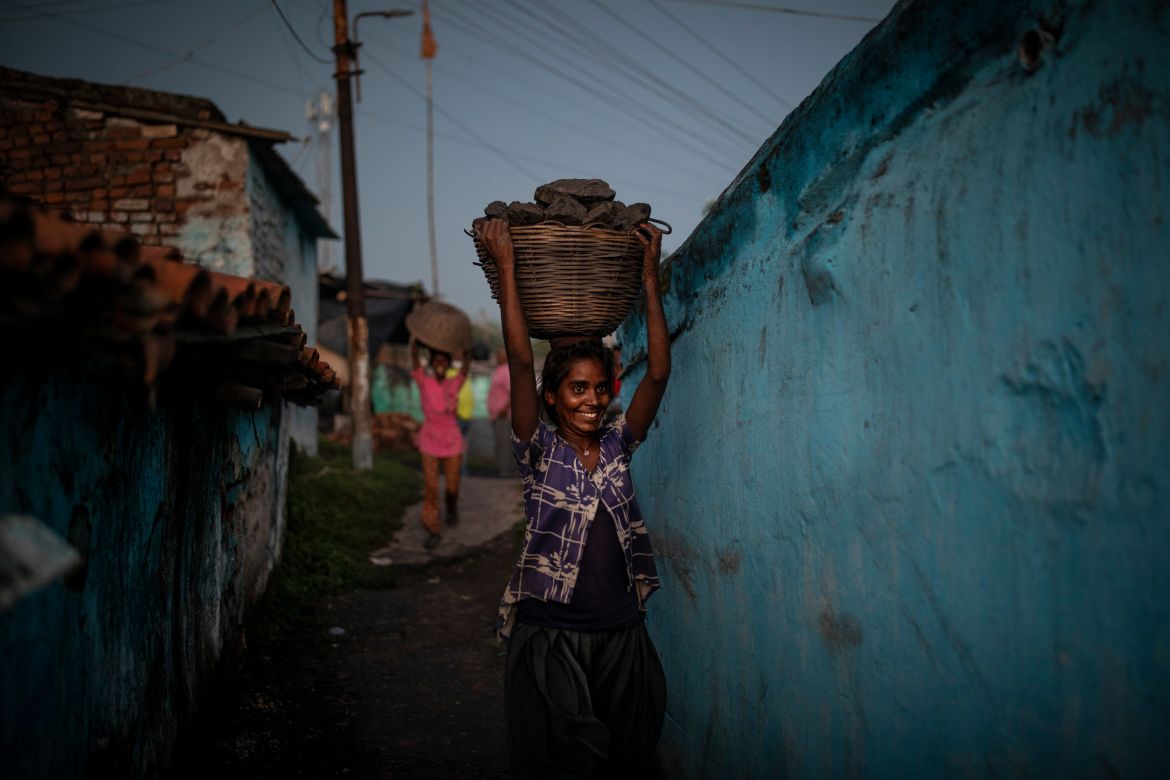
A young woman carries a basket of coal scavenged from a mine. Families who have lived amid coal mines for generations rarely own any land they can farm and have nowhere else to go. [Altaf Qadri/AP Photo]
Advertisement
Murti Devi, who scavenges coal for living, prepares a hearth fuelled by coal at a village near Dhanbad. The 32-year-old single mother of four lost the job she had all her life when the mine she worked for closed four years ago. Nothing came of the resettlement plans promised by the coal company so she, like so many others, turned to scavenging coal. On good days, she will make a dollar. On other days, she relies on neighbours for help. “If there is coal, then we live. If there isn’t any coal, then we don’t live,” she said. [Altaf Qadri/AP Photo]
Smoke hisses from cracks in the ground as a villager holds his child in front of houses damaged due to subsidence near Dhanbad. [Altaf Qadri/AP Photo]
A washerman uses coal to heat up iron in Dhanbad. Power demand in India is expected to grow faster than anywhere in the world over the next two decades as the economy grows. [Altaf Qadri/AP Photo]
Members of coal workers' community fetch drinking water from a pipe at a coal depot near an open-cast mine in Dhanbad. [Altaf Qadri/AP Photo]
Flames rise out of the fissures in the ground above coal mines in the village of Liloripathra near Dhanbad. Accidental fires, some of which have been blazing for decades, have charred the ground and left it spongy. Smoke hisses from cracks in the surface near their hut. Fatal sinkholes are common. [Altaf Qadri/AP Photo]
Mining is in progress at an open-cast mine near Dhanbad, an eastern Indian city in Jharkhand state, Friday, Sept. 24, 2021.
Mining in progress at an open-cast mine near Dhanbad. [Altaf Qadri/AP Photo]
A truck loaded with coal drives past a stationary freight train carrying coal at Chainpur village near Hazaribagh in Jharkhand. India's coal belt is dotted by industries that need the fuel, like steel and brick making. Indian Railways, one of the country's largest employers, earns half its revenue by transporting coal, allowing it to subsidise passenger travel. [Altaf Qadri/AP Photo]

Related

  • As coal stocks shrink, India faces growing energy shortage crisis

    Power stations only have average of four days’ worth of fuel while more than 50 percent of plants are on outage alert.

    Published On 6 Oct 20216 Oct 2021
    Coal
  • ‘Tiger on my farm’: India coal hub brings new dangers in villages

    With a population of 1.3 billion, India is vulnerable to human-animal conflict as people encroach on wildlife habitats.

    Published On 9 Sep 20219 Sep 2021
    Tiger
  • Climate crisis: How Bangladeshis are fighting rising sea levels

    Global Climate Risk Index says Bangladesh is seventh among nations most affected by extreme weather in past two decades.

    Published On 28 Oct 202128 Oct 2021
    Farmers wade through an inundated field past vegetables growing on seedbeds. [Munir uz Zaman/AFP]
    This gallery article has 7 imagescamera7
  • COP26: What developing countries need to fight the climate crisis

    Will world leaders deliver a finance package that helps developing countries meet or even exceed climate goals?

    Published On 29 Oct 202129 Oct 2021
    The developing world needs somewhere in the order of about $3.5 trillion up to 2030 alone for reducing emissions, putting in renewable energy infrastructure and other measures [File: Russell Cheyne/Reuters]

More from Gallery

  • Photos: Manila’s streets empty as fuel prices surge amid Hormuz crisis

    A sharp increase in prices of basic commodities and the possible loss of employment for thousands of people due to the fuel price hike have raised the spectre of stagflation in the Philippines.
    This gallery article has 10 imagescamera10
  • Photos: More than one million displaced by Israel’s evacuations in Lebanon

    Over one million displaced by Israel’s evacuations in Lebanon
    This gallery article has 10 imagescamera10
  • Migrants march in southern Mexico to denounce immigration restrictions

    Migrants, some carrying children, walk on the highway through the municipality of Huehuetan, Chiapas state, Mexico, Wednesday, March 25, 2026, after leaving Tapachula the previous night. (AP Photo/Edgar H. Clemente)
    This gallery article has 9 imagescamera9
  • Photos: Iran fires new waves of missiles at Israel

    This picture shows damaged buildings at the site of an Iranian missile strike in Tel Aviv
    This gallery article has 8 imagescamera8

Most popular

  • Tehran vows to extract ‘heavy price’ for Israeli hits on two nuclear sites

    TOPSHOT - This video grab taken from images released by the Iranian state broadcaster (IRIB) on March 26, 2026, shows what it says is the second phase of the 82nd wave of missiles launched against Israel and US bases in the United Arab Emirates and Kuwait.
  • US diplomat Marco Rubio denounces settler violence, tolls in Hormuz strait

    US Secretary of State Marco Rubio looks on as he speaks to the press before his departure following a G7 Foreign Ministers' meeting with Partner Countries before his departure at the Bourget airport in Le Bourget, outside Paris, France, March 27, 2026. Brendan Smialowski/Pool via REUTERS
  • FBI director Kash Patel’s emails, photos hacked by Iran-linked group

    FILE PHOTO: FBI Director Kash Patel announces the apprehension of Ryan Wedding, a former Canadian Olympic snowboarder who was on the FBI's Ten Most Wanted Fugitive list, during a press conference in Ontario, California, U.S., January 23, 2026. REUTERS/Mike Blake//File Photo
  • How extensive is Russia’s military aid to Iran?

    Iranian missile strikes

  • About

    • About Us
    • Code of Ethics
    • Terms and Conditions
    • EU/EEA Regulatory Notice
    • Privacy Policy
    • Cookie Policy
    • Cookie Preferences
    • Accessibility Statement
    • Sitemap
    • Work for us
  • Connect

    • Contact Us
    • User Accounts Help
    • Advertise with us
    • Stay Connected
    • Newsletters
    • Channel Finder
    • TV Schedule
    • Podcasts
    • Submit a Tip
    • Paid Partner Content
  • Our Channels

    • Al Jazeera Arabic
    • Al Jazeera English
    • Al Jazeera Investigative Unit
    • Al Jazeera Mubasher
    • Al Jazeera Documentary
    • Al Jazeera Balkans
    • AJ+
  • Our Network

    • Al Jazeera Centre for Studies
    • Al Jazeera Media Institute
    • Learn Arabic
    • Al Jazeera Centre for Public Liberties & Human Rights
    • Al Jazeera Forum
    • Al Jazeera Hotel Partners

Follow Al Jazeera English:

  • facebook
  • twitter
  • youtube
  • instagram-colored-outline
  • rss
Al Jazeera Media Network logo
© 2026 Al Jazeera Media Network