Skip linksSkip to Content
play
Live
Navigation menu
  • News
    • Africa
    • Asia
    • US & Canada
    • Latin America
    • Europe
    • Asia Pacific
  • Middle East
  • Explained
  • Opinion
  • Sport
  • Video
    • Features
    • Economy
    • Human Rights
    • Climate Crisis
    • Investigations
    • Interactives
    • In Pictures
    • Science & Technology
    • Podcasts
    • Travel
play
Live

In Pictures

Gallery|Environment

Chile’s desert dumping ground for fast fashion leftovers

Chile’s Atacama, the driest desert in the world, is increasingly suffering from pollution caused by fast fashion.

Save

Share

facebooktwitterwhatsappcopylink
Used clothes discarded in the Atacama Desert, in Alto Hospicio, Iquique, Chile. [Martin Bernetti/AFP]
By AFP
Published On 8 Nov 20218 Nov 2021

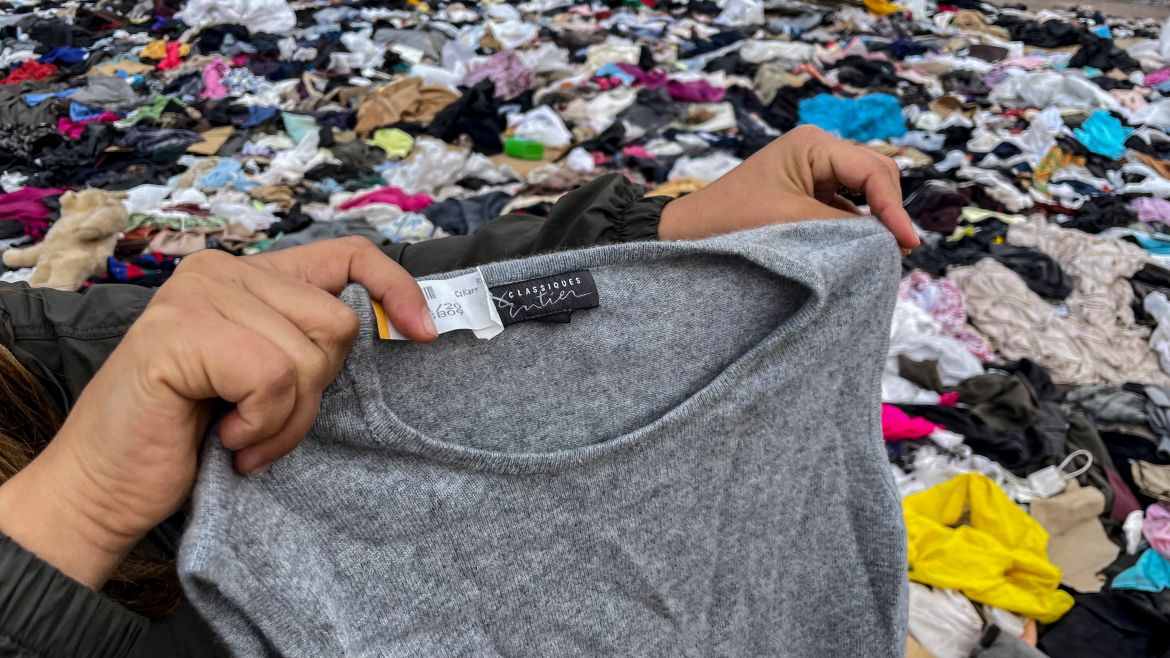
A mountain of discarded clothing, including Christmas sweaters and ski boots, cuts a strange sight in Chile’s Atacama, the driest desert in the world, which is increasingly suffering from pollution created by fast fashion.

The social effect of rampant consumerism in the clothing industry – such as child labour in factories or derisory wages – is well-known, but the disastrous effect on the environment is less publicised.

Chile has long been a hub of second-hand and unsold clothing, made in China or Bangladesh and passing through Europe, Asia or the United States before arriving in Chile, where it is resold around Latin America.

Some 59,000 tonnes of clothing arrive each year at the Iquique port in the Alto Hospicio free zone in northern Chile.

Clothing merchants from the capital Santiago, 1,800km (1,100 miles) to the south, buy some, while much is smuggled out to other Latin American countries. But at least 39,000 tonnes that cannot be sold end up in rubbish dumps in the desert.

“This clothing arrives from all over the world,” Alex Carreno, a former employee in the port’s import area, told the AFP news agency.

“What is not sold to Santiago nor sent to other countries stays in the free zone” as no one pays the necessary tariffs to take it away.

“The problem is that the clothing is not biodegradable and has chemical products, so it is not accepted in the municipal landfills,” said Franklin Zepeda, the founder of EcoFibra, a company that makes insulation panels using discarded clothing.

Advertisement

“I wanted to stop being the problem and start being the solution,” he told AFP about the firm he created in 2018.

Water waste

According to a 2019 UN report, global clothing production doubled between 2000 and 2014, and the industry is “responsible for 20 percent of total water waste on a global level”.

To make a single pair of jeans requires 7,500 litres (2,000 gallons) of water.

The same report said clothing and footwear manufacturing contributes 8 percent of global greenhouse gases, and that “every second, an amount of textiles equivalent to a garbage truck is buried or burned”.

Whether the clothing piles are left out in the open or buried underground, they pollute the environment, releasing pollutants into the air or underground water channels.

Clothing, either synthetic or treated with chemicals, can take 200 years to biodegrade and is as toxic as discarded tyres or plastic materials.

Chile, the richest country in South America, is known for the voracious consumerism of its inhabitants.

Things are changing, though, according to Rosario Hevia, who opened a store to recycle children’s clothes before founding in 2019 Ecocitex, a company that creates yarn from pieces of discarded textiles and clothing in a poor state. The process uses neither water nor chemicals.

“For many years we consumed, and no one seemed to care that more and more textile waste was being generated,” she said.

“But now, people are starting to question themselves.”

Women search for used clothes amid tonnes discarded in the Atacama Desert. Some 59,000 tonnes of clothing arrive each year at the Iquique port in the Alto Hospicio free zone in northern Chile. [Martin Bernetti/AFP]
Advertisement
The textile industry in Chile will be included in the law of Extended Responsibility of the Producer (REP), forcing clothes and textiles importers to take charge of the waste they generate. [Martin Bernetti/AFP]
Men work at a factory that recycles used clothes discarded in the Atacama Desert for wooden isolation panels for the walls of social housing. [Martin Bernetti/AFP]
Men work at a factory that recycles used clothes discarded in the Atacama Desert. [Martin Bernetti/AFP]
A man discards used clothes at a container of the Ecotex ecologic yarn factory in Santiago. [Martin Bernetti/AFP]
A worker rips metal buttons off a pair of jeans at a recycling factory. [Martin Bernetti/AFP]
Advertisement
Ecologic yarns made of used clothes at the Ecotex factory. [Martin Bernetti/AFP]
A woman shops for used clothes at the Ecotex ecologic yarn factory. [Martin Bernetti/AFP]
A woman searches for used clothes amid tonnes discarded in the Atacama Desert. Clothing, either synthetic or treated with chemicals, can take 200 years to biodegrade and is as toxic as discarded tyres or plastic materials. [Martin Bernetti/AFP]

Related

  • ‘Junk’: Faulty electronics from rich countries flood Nigeria with e-waste

    Discarded, near-end-of-life electronics shipped from developed countries are adding to Nigeria’s growing e-waste burden.

    Published On 27 Mar 202627 Mar 2026
    Market in Kano, Nigeria
  • From: NewsFeed

    Endangered monarch butterfly population surges 64 percent

    Mexico’s monarch butterfly population surged 64 percent this winter.

    Published On 27 Mar 202627 Mar 2026
    A monarch butterfly pauses in a garden, July 11, 2021, in Marple Township, Pa. [Matt Slocum/AP Photo]
    Video Duration 00 minutes 55 seconds play-arrow00:55
  • From: NewsFeed

    Video: Storms wash away vehicles and flood homes across Middle East

    Vehicles were washed away in floods in Oman and homes were flooded in Syria as storms brought floods across the region.

    Published On 26 Mar 202626 Mar 2026
    Video Duration 01 minutes 26 seconds play-arrow01:26
  • Long before Trump: How US policy has harmed the environment for decades

    Environment advocacy groups are suing the US government over climate change policy rollback.

    Published On 20 Mar 202620 Mar 2026
    Obama

More from Gallery

  • Photos: Manila’s streets empty as fuel prices surge amid Hormuz crisis

    A sharp increase in prices of basic commodities and the possible loss of employment for thousands of people due to the fuel price hike have raised the spectre of stagflation in the Philippines.
    This gallery article has 10 imagescamera10
  • Photos: More than one million displaced by Israel’s evacuations in Lebanon

    Over one million displaced by Israel’s evacuations in Lebanon
    This gallery article has 10 imagescamera10
  • Migrants march in southern Mexico to denounce immigration restrictions

    Migrants, some carrying children, walk on the highway through the municipality of Huehuetan, Chiapas state, Mexico, Wednesday, March 25, 2026, after leaving Tapachula the previous night. (AP Photo/Edgar H. Clemente)
    This gallery article has 9 imagescamera9
  • Photos: Iran fires new waves of missiles at Israel

    This picture shows damaged buildings at the site of an Iranian missile strike in Tel Aviv
    This gallery article has 8 imagescamera8

Most popular

  • Iran targets Saudi capital, hits Kuwait port as Middle East tensions surge

    TOPSHOT - This video grab taken from images released by the Iranian state broadcaster (IRIB) on March 26, 2026, shows what it says is the second phase of the 82nd wave of missiles launched against Israel and US bases in the United Arab Emirates and Kuwait.
  • How extensive is Russia’s military aid to Iran?

    Iranian missile strikes
  • US-Israel war on Iran: What’s happening on day 28 of attacks?

    Protesters attend a rally.
  • Iran war updates: US, Israel attack ignites worst trade rupture in 80 years

    This handout image taken by the European Space Agency (ESA) captured by the Copernicus Sentinel-2 satellite shows a view of smoke plumes billowing in the vicinity Kuwait International Airport on March 25, 2026.

  • About

    • About Us
    • Code of Ethics
    • Terms and Conditions
    • EU/EEA Regulatory Notice
    • Privacy Policy
    • Cookie Policy
    • Cookie Preferences
    • Accessibility Statement
    • Sitemap
    • Work for us
  • Connect

    • Contact Us
    • User Accounts Help
    • Advertise with us
    • Stay Connected
    • Newsletters
    • Channel Finder
    • TV Schedule
    • Podcasts
    • Submit a Tip
    • Paid Partner Content
  • Our Channels

    • Al Jazeera Arabic
    • Al Jazeera English
    • Al Jazeera Investigative Unit
    • Al Jazeera Mubasher
    • Al Jazeera Documentary
    • Al Jazeera Balkans
    • AJ+
  • Our Network

    • Al Jazeera Centre for Studies
    • Al Jazeera Media Institute
    • Learn Arabic
    • Al Jazeera Centre for Public Liberties & Human Rights
    • Al Jazeera Forum
    • Al Jazeera Hotel Partners

Follow Al Jazeera English:

  • facebook
  • twitter
  • youtube
  • instagram-colored-outline
  • rss
Al Jazeera Media Network logo
© 2026 Al Jazeera Media Network