Skip linksSkip to Content
play
Live
Navigation menu
  • News
    • Africa
    • Asia
    • US & Canada
    • Latin America
    • Europe
    • Asia Pacific
  • Middle East
  • Explained
  • Opinion
  • Sport
  • Video
    • Features
    • Economy
    • Human Rights
    • Climate Crisis
    • Investigations
    • Interactives
    • In Pictures
    • Science & Technology
    • Podcasts
    • Travel
play
Live

In Pictures

Gallery|Environment

In Pictures: Is avocado boom to blame for bee deaths in Colombia?

Apiarists in Colombia suspect pesticides used in commercial avocado and citrus farming is killing the bees.
Save

Share

facebooktwitterwhatsappcopylink
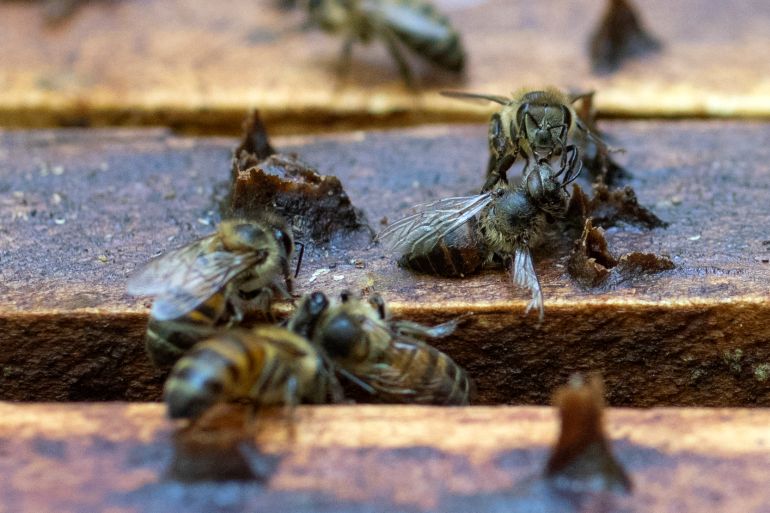
A poisoned beehive in Santa Fe de Antioquia. [Joaquin Sarmiento/AFP]
By AFP
Published On 2 Mar 20212 Mar 2021

For the second time in two years, Gildardo Urrego is scooping up piles of dead bees after an invisible evil invaded his hives in northwest Colombia, wreaking havoc among his swarms.

Urrego has no proof, but he suspects the culprit is pesticides that have been fuelling a commercial avocado and citrus boom in the country.

Hundreds of hives have been killed off in Colombia in recent years, and some investigations have pointed to fipronil, an insecticide banned for use on crops in Europe and restricted in the United States and China.

It is used to control all manner of insects, including ants and ticks, and has been blamed for several bee massacres around the world.

Urrego’s apiary in Colombia’s Antioquia Department produces honey flavoured with pollen from nearby passion fruit orchards. In 2019, he lost 10 of his 19 hives.

This time, he said, one-third of his 12 hives were wiped out – a loss of some 160,000 of the industrious little pollinators.

“There is a theory that, yes, this is due to poisoning, there are some crops around here that perhaps have not managed their agrochemicals well and so this area was affected,” he told AFP.

In recent years, bees in North America, Europe, Russia, South America and elsewhere have started dying off from “colony collapse disorder”, a mysterious scourge blamed partly on pesticides along with mites, viruses and fungi.

The UN warns that nearly half of insect pollinators, particularly bees and butterflies, risk global extinction.

Beeekeeper Abdon Salazar checks a healthy beehive at his apiary in Calarca, Quindio department, about 277km (172 miles) east of Colombian capital Bogota. [Joaquin Sarmiento/AFP]
Advertisement
Salazar points the finger of blame at fipronil for the deaths of bees. About 1.4 billion jobs and three-quarters of all crops around the world, according to a 2016 study, depend on pollinators, mainly bees. [Joaquin Sarmiento/AFP]
Beekeeper Gildardo Urrego checks a poisoned beehive at his apiary in Santa Fe de Antioquia, about 480km (300 miles) northwest of Bogota. Beekeepers in the region are increasingly having to clear out mounds of dead bees from their apiaries, which are surrounded by avocado and citrus plantations in an exceptionally fertile and biodiverse part of the world. [Joaquin Sarmiento/AFP]
In recent years, bees in North America, Europe, Russia, South America and elsewhere have started dying off from "colony collapse disorder", a mysterious scourge blamed partly on pesticides along with mites, viruses and fungi. [Joaquin Sarmiento/AFP]
The UN warns that nearly half of insect pollinators, particularly bees and butterflies, are at risk of global extinction. [Joaquin Sarmiento/AFP]
A man fumigates an avocado plant near an apiary in Calarca, Quindio department. Last year, the state-owned Colombian Agricultural Institute (ICA) was notified by beekeepers of 256 suspected hive poisonings in Quindio alone. [Joaquin Sarmiento/AFP]
Advertisement
A passionfruit plantation near an apiary in Santa Fe de Antioquia. [Joaquin Sarmiento/AFP]

Related

  • OPINIONOPINION,

    Economic sanctions are triggering environmental damage

    The US cannot become a climate leader without addressing the environmental impacts of its economic sanctions.

    Opinion by Barney Bartlett and Shirin HakimBarney Bartlett|Shirin Hakim
    Published On 15 Feb 202115 Feb 2021
    Significant sections of the biodiverse Mesopotamian Marshes, a recognised UNESCO World Heritage Site located in southern Iraq and southwestern Iran, have been partially drained to reclaim land for agriculture or oil exploration in recent decades. Photo taken in Nasiriya, Iraq on December 24, 2020 [Murtadha Al-Sudani/Anadolu Agency]
    quotes
  • Green investors are pushing firms to assess environmental effects

    ‘Extinction accounting’ and other new financial methods aim to put a price on a company’s environmental effects.

    Published On 18 Dec 202018 Dec 2020
    A project to assess how companies are contributing to the death of honey bees is among new initiatives to encourage firms to incorporate environmental costs into their accounts [File: Toby Melville/Reuters]
  • Toxins in plastic blamed for health, environment hazards

    Report warns exposure to toxic chemicals in everyday consumer goods could result in cancers, damage to immune system.

    Published On 30 Sep 202030 Sep 2020
    People and the planet are exposed to toxic chemicals in plastic at all stages including recycling [Ricardo Franco/EPA]
  • OPINIONOPINION,

    Why environmental justice is an anti-colonial struggle

    It is increasingly clear that systemic oppression and environmental collapse are inextricably linked.

    Opinion by Michael Wilson-BecerrilMichael Wilson-Becerril
    Published On 22 Sep 202022 Sep 2020
    In this Monday, Aug. 17, 2020 file photo, flames from the River Fire crest a ridge in Salinas, Calif.
    quotes

More from Gallery

  • Photos: Manila’s streets empty as fuel prices surge amid Hormuz crisis

    A sharp increase in prices of basic commodities and the possible loss of employment for thousands of people due to the fuel price hike have raised the spectre of stagflation in the Philippines.
    This gallery article has 10 imagescamera10
  • Photos: More than one million displaced by Israel’s evacuations in Lebanon

    Over one million displaced by Israel’s evacuations in Lebanon
    This gallery article has 10 imagescamera10
  • Migrants march in southern Mexico to denounce immigration restrictions

    Migrants, some carrying children, walk on the highway through the municipality of Huehuetan, Chiapas state, Mexico, Wednesday, March 25, 2026, after leaving Tapachula the previous night. (AP Photo/Edgar H. Clemente)
    This gallery article has 9 imagescamera9
  • Photos: Iran fires new waves of missiles at Israel

    This picture shows damaged buildings at the site of an Iranian missile strike in Tel Aviv
    This gallery article has 8 imagescamera8

Most popular

  • Iran targets Saudi capital, hits Kuwait port as Middle East tensions surge

    TOPSHOT - This video grab taken from images released by the Iranian state broadcaster (IRIB) on March 26, 2026, shows what it says is the second phase of the 82nd wave of missiles launched against Israel and US bases in the United Arab Emirates and Kuwait.
  • How extensive is Russia’s military aid to Iran?

    Iranian missile strikes
  • US-Israel war on Iran: What’s happening on day 28 of attacks?

    Protesters attend a rally.
  • Iran war updates: US, Israel attack ignites worst trade rupture in 80 years

    This handout image taken by the European Space Agency (ESA) captured by the Copernicus Sentinel-2 satellite shows a view of smoke plumes billowing in the vicinity Kuwait International Airport on March 25, 2026.

  • About

    • About Us
    • Code of Ethics
    • Terms and Conditions
    • EU/EEA Regulatory Notice
    • Privacy Policy
    • Cookie Policy
    • Cookie Preferences
    • Accessibility Statement
    • Sitemap
    • Work for us
  • Connect

    • Contact Us
    • User Accounts Help
    • Advertise with us
    • Stay Connected
    • Newsletters
    • Channel Finder
    • TV Schedule
    • Podcasts
    • Submit a Tip
    • Paid Partner Content
  • Our Channels

    • Al Jazeera Arabic
    • Al Jazeera English
    • Al Jazeera Investigative Unit
    • Al Jazeera Mubasher
    • Al Jazeera Documentary
    • Al Jazeera Balkans
    • AJ+
  • Our Network

    • Al Jazeera Centre for Studies
    • Al Jazeera Media Institute
    • Learn Arabic
    • Al Jazeera Centre for Public Liberties & Human Rights
    • Al Jazeera Forum
    • Al Jazeera Hotel Partners

Follow Al Jazeera English:

  • facebook
  • twitter
  • youtube
  • instagram-colored-outline
  • rss
Al Jazeera Media Network logo
© 2026 Al Jazeera Media Network