Skip linksSkip to Content
play
Live
Navigation menu
  • News
    • Africa
    • Asia
    • US & Canada
    • Latin America
    • Europe
    • Asia Pacific
  • Middle East
  • Explained
  • Opinion
  • Sport
  • Video
    • Features
    • Economy
    • Human Rights
    • Climate Crisis
    • Investigations
    • Interactives
    • In Pictures
    • Science & Technology
    • Podcasts
    • Travel
play
Live

In Pictures

Gallery|Water

In Pictures: Across US West, drought arriving dangerously early

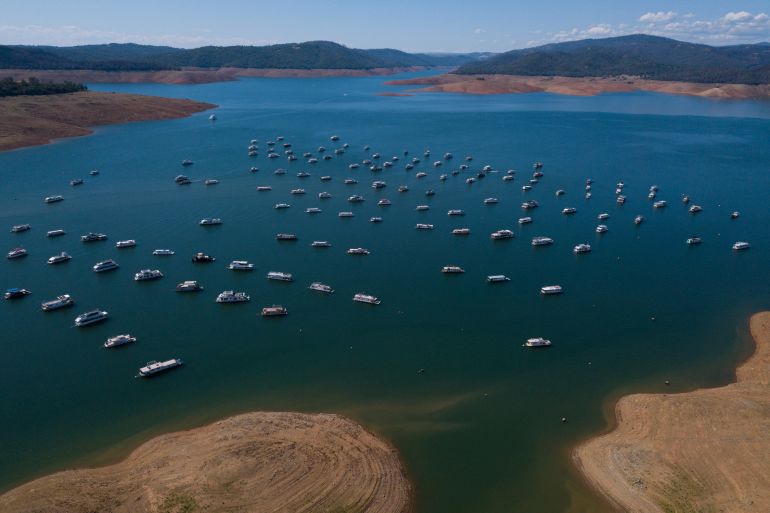
The second-largest reservoir in California is at less than half of its average capacity at this time of year.
Save

Share

facebooktwitterwhatsappcopylink
In this aerial image, houseboats are moored as dry land is exposed on the banks of Lake Oroville reservoir due to low water levels during the California drought emergency in Oroville, California. [Patrick T. Fallon/AFP]
By AFP
Published On 14 Jun 202114 Jun 2021

Lakes at historically low levels, unusually early forest fires, restrictions on water use and now a potentially record heatwave: even before summer’s start the United States’ West is suffering the effects of chronic drought made worse by climate change.

Eighty-eight per cent of the West was in a state of drought this week, including the entire states of California, Oregon, Utah and Nevada, according to official data.

In a particularly stark symptom of this trend, which is affecting more than 143 million Americans, Lake Mead – the country’s largest reservoir, lying at the border of Nevada and Arizona – now stands at its lowest level since its creation in the 1930s.

The lake, formed when the huge Hoover Dam was built across the Colorado River not far from Las Vegas, stands at just 36 per cent of capacity, below even a record set in 2016.

Authorities expected something like this – but not until August.

The situation in northern California, which normally receives ample precipitation in the winter and spring, is no better. Lake Oroville, the state’s second-largest reservoir and a key part of a network providing potable water to 27 million Californians, is 50 metres (165 feet) lower than in 2019.

Widespread water-use restrictions appear inevitable over the coming months, with potentially serious ramifications for Western states, in particular for irrigation-dependent farmers – who provide much of the country’s fruits and vegetables.

In California, whose vast almond groves supply 80 per cent of world production, some farmers have already begun uprooting trees to save water.

Advertisement

As of April 1, the date traditionally marking the area’s last snowfall, the snowpack on the upper slopes of the Sierra Nevada – source of roughly a third of all water used in California – was at only 60 percent of average.

“Really, one thing unique this year is that as the snow melted, the runoff ended up soaking into dry soils and ended up evaporating,” never reaching Lake Oroville, John Yarbrough, an official with the California Department of Water Resources, told the AFP news agency.

“So that’s what was unusual this year, how little runoff we got from that snowpack.”

According to the US Drought Monitor, one-third of California is currently experiencing “exceptional drought”, the worst level.

And dry soils and water-deprived vegetation create the conditions for even higher temperatures, feeding a devastating vicious circle.

Meteorologists have issued heat warnings, saying that Las Vegas, for example, could hit 115 Fahrenheit (46 Celsius), surpassing a record established in 1940.

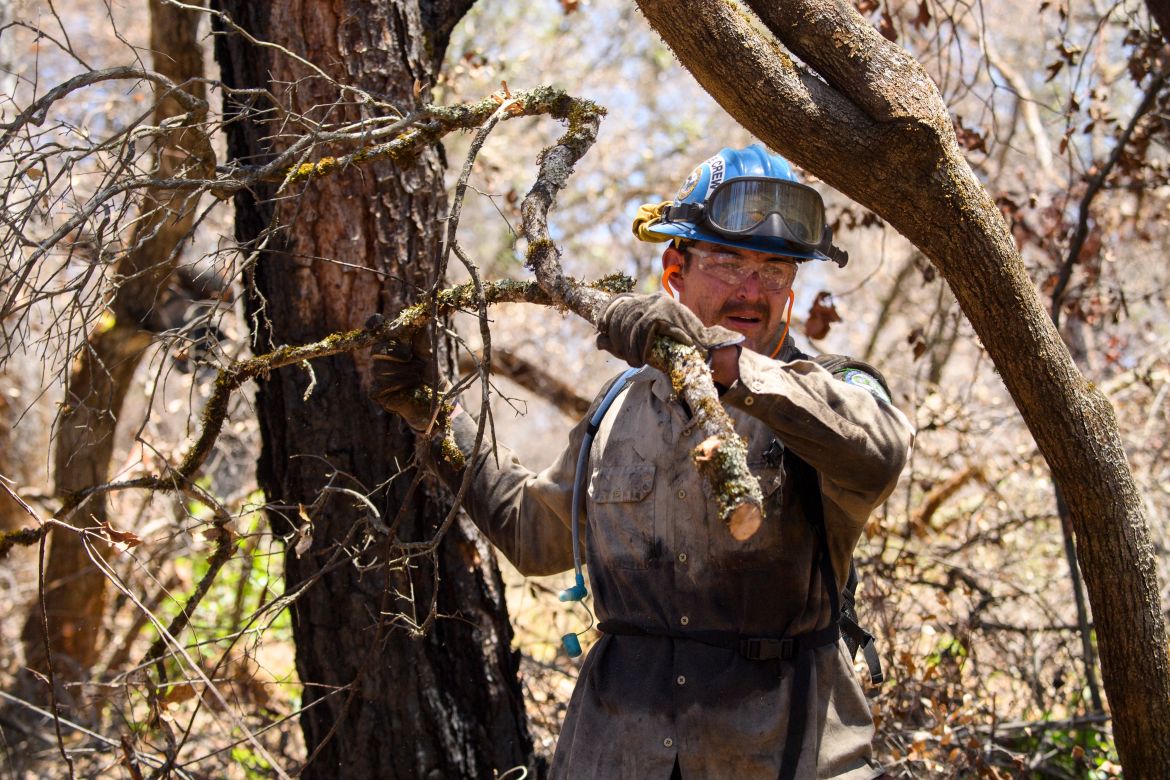
Authorities are particularly concerned about forest fires, which have arrived unusually early this year and with rare intensity. As of the end of May, fires in California had already destroyed five times as much vegetation as they had last year at this point.

Dead and dying fish lie in a small pool of water cut off from the main body as water levels continue to recede at the Lake Oroville reservoir. [Patrick T. Fallon/AFP]
Advertisement
An aerial image shows a dead tree previously covered by water and dry land exposed on the banks of Lake Oroville reservoir due to low water levels during the California drought emergency in Oroville. [Patrick T. Fallon/AFP]
A California Conservation Corps firefighter carries a branch, a potential fuel source for a fire, towards a wood chipper during a fuel reduction operation with the Cal Fire/Butte County Fire Department and firefighters from the California Conservation Corps near Lake Oroville. [Patrick T. Fallon/AFP]
Houseboats are moored on Lake Oroville reservoir during the California drought emergency in Oroville, California. - Summer has not even begun and Lake Oroville, the second-largest reservoir in California that provides drinking water to more than 25 million people, is at less than half of its average capacity at this time of year. [Patrick T. Fallon/AFP]
John Yarbrough, assistant deputy director with the California State Water Project holds dry soil that would normally be underwater as he speaks at the Lake Oroville reservoir. [Patrick T. Fallon/AFP]
A bird taking flight as empty boat slips sit on a dry lake bed at Folsom Lake Marina, with the lake experiencing lower water levels in El Dorado Hills, California. On May 10, California Governor Gavin Newsom declared a state of drought emergency in 41 counties, including El Dorado County where Folsom Lake is located. [Patrick T. Fallon/AFP]
Advertisement
A resident waits for a construction inspection at the site of a structure being rebuilt following the Bear Fire, part of the North Complex Fire, during the current California drought emergency near Berry Creek, California. [Patrick T. Fallon/AFP]
The Enterprise Bridge and dead trees burned in a recent wildfire stand as dry land is exposed on the banks of Lake Oroville reservoir due to low water levels during the California drought emergency. [Patrick T. Fallon/AFP]
In a worrying indication of the worsening drought conditions in the northern part of the Golden State, the Lake Oroville reservoir is dangerously low. [Patrick T. Fallon/AFP]

Related

  • Israel hinders repair of damaged water infra deepening Gaza’s health crisis

    Palestinian engineers struggle to repair Gaza’s water system, which has been contaminated, posing a health risk.

    Published On 26 Mar 202626 Mar 2026
    Displaced Palestinians wait to fill jerrycans with water collected from a desalination plant in Khan Yunis, southern Gaza Strip, on February 7, 2026.
  • ‘How do I survive?’ Drought plagues Kenya’s Turkana amid surplus elsewhere

    As a quarter of Kenya’s population faces severe food shortages, up to 40% of food produced is lost or wasted each year.

    Published On 17 Mar 202617 Mar 2026
    Women carry water canisters on their heads.
  • How much of the Gulf’s water comes from desalination plants?

    Gulf states produce 40 percent of the world’s total desalinated water through more than 400 plants.

    Published On 12 Mar 202612 Mar 2026
    INTERACTIVE - Map world rivers desalination gulf-1773312047
  • Glacier grafting: How an Indigenous art is countering water scarcity

    Residents in the northern part of Pakistan are creating artificial glaciers to tackle climate change.

    Published On 17 Feb 202617 Feb 2026
    Pakistan Glacier

More from Gallery

  • Photos: Manila’s streets empty as fuel prices surge amid Hormuz crisis

    A sharp increase in prices of basic commodities and the possible loss of employment for thousands of people due to the fuel price hike have raised the spectre of stagflation in the Philippines.
    This gallery article has 10 imagescamera10
  • Photos: More than one million displaced by Israel’s evacuations in Lebanon

    Over one million displaced by Israel’s evacuations in Lebanon
    This gallery article has 10 imagescamera10
  • Migrants march in southern Mexico to denounce immigration restrictions

    Migrants, some carrying children, walk on the highway through the municipality of Huehuetan, Chiapas state, Mexico, Wednesday, March 25, 2026, after leaving Tapachula the previous night. (AP Photo/Edgar H. Clemente)
    This gallery article has 9 imagescamera9
  • Photos: Iran fires new waves of missiles at Israel

    This picture shows damaged buildings at the site of an Iranian missile strike in Tel Aviv
    This gallery article has 8 imagescamera8

Most popular

  • Iran targets Saudi capital, hits Kuwait port as Middle East tensions surge

    TOPSHOT - This video grab taken from images released by the Iranian state broadcaster (IRIB) on March 26, 2026, shows what it says is the second phase of the 82nd wave of missiles launched against Israel and US bases in the United Arab Emirates and Kuwait.
  • How extensive is Russia’s military aid to Iran?

    Iranian missile strikes
  • US-Israel war on Iran: What’s happening on day 28 of attacks?

    Protesters attend a rally.
  • Iran war updates: US, Israel attack ignites worst trade rupture in 80 years

    This handout image taken by the European Space Agency (ESA) captured by the Copernicus Sentinel-2 satellite shows a view of smoke plumes billowing in the vicinity Kuwait International Airport on March 25, 2026.

  • About

    • About Us
    • Code of Ethics
    • Terms and Conditions
    • EU/EEA Regulatory Notice
    • Privacy Policy
    • Cookie Policy
    • Cookie Preferences
    • Accessibility Statement
    • Sitemap
    • Work for us
  • Connect

    • Contact Us
    • User Accounts Help
    • Advertise with us
    • Stay Connected
    • Newsletters
    • Channel Finder
    • TV Schedule
    • Podcasts
    • Submit a Tip
    • Paid Partner Content
  • Our Channels

    • Al Jazeera Arabic
    • Al Jazeera English
    • Al Jazeera Investigative Unit
    • Al Jazeera Mubasher
    • Al Jazeera Documentary
    • Al Jazeera Balkans
    • AJ+
  • Our Network

    • Al Jazeera Centre for Studies
    • Al Jazeera Media Institute
    • Learn Arabic
    • Al Jazeera Centre for Public Liberties & Human Rights
    • Al Jazeera Forum
    • Al Jazeera Hotel Partners

Follow Al Jazeera English:

  • facebook
  • twitter
  • youtube
  • instagram-colored-outline
  • rss
Al Jazeera Media Network logo
© 2026 Al Jazeera Media Network