Skip linksSkip to Content
play
Live
Navigation menu
  • News
    • Africa
    • Asia
    • US & Canada
    • Latin America
    • Europe
    • Asia Pacific
  • Middle East
  • Explained
  • Opinion
  • Sport
  • Video
    • Features
    • Economy
    • Human Rights
    • Climate Crisis
    • Investigations
    • Interactives
    • In Pictures
    • Science & Technology
    • Podcasts
    • Travel
play
Live

In Pictures

Gallery|Arts and Culture

‘Higher learning’: Of scriptures and football at a Tibet college

The Tibetan Buddhist College, one of the highest places of learning on the planet, has more than 900 students studying Mandarin, English and political studies under the benign gaze of China’s President Xi Jinping.
Save

Share

facebooktwitterwhatsappcopylink
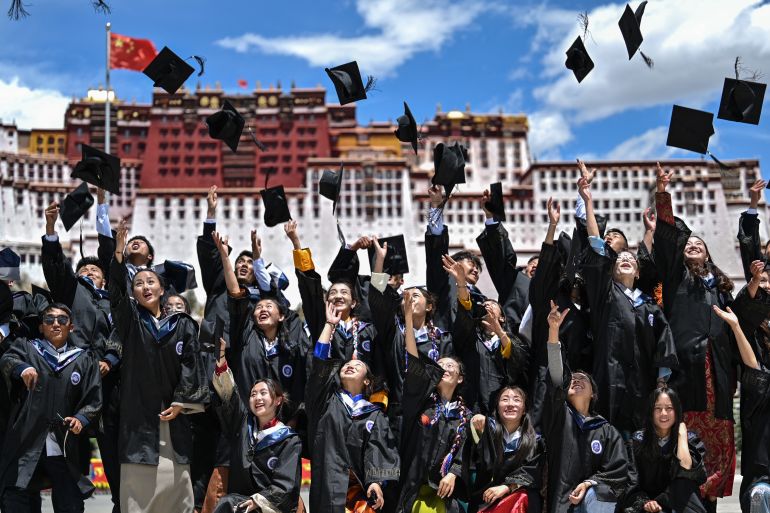
College of Science graduates from Tibet University celebrate their graduation at the Potala Palace Square. [Hector Retamal/AFP]
By AFP
Published On 2 Jun 20212 Jun 2021

Maroon-robed Tibetan nuns vigorously debate Buddhist precepts, while monks dash across an artificial grass pitch on the roof of the world to kick a football.

The Tibetan Buddhist College, one of the highest places of learning on the planet, has more than 900 students who study Mandarin, English and political studies.

It all takes place under the benign gaze of China’s President Xi Jinping, whose portrait festoons the college, which is tucked into a hillside at least 3,600 metres (11,800 feet) above sea level.

Beijing says it “peacefully liberated” the mountainous region of Tibet in 1951 and insists it has since brought infrastructure and education to a previously underdeveloped region.

Chinese flags and the aphorisms of Xi pepper the college grounds.

But there are no signs of Tibetan spiritual leader the Dalai Lama, who fled the region in 1959 and set up a government-in-exile in India.

AFP news agency joined a government-steered media tour this week to the politically sensitive region.

Since 2008, it has been nearly impossible for journalists to visit except on organised trips.

Sporadic protests have broken out in Tibet in recent decades, including some self-immolations by monks in the heart of Lhasa and large protests against Chinese rule in 2008, which left many dead.

Rights groups say that now expressing any anti-government view is extremely dangerous, while simmering unrest is quickly stamped out.

During the media tour, the college students were glowing in their praise of their education.

Advertisement

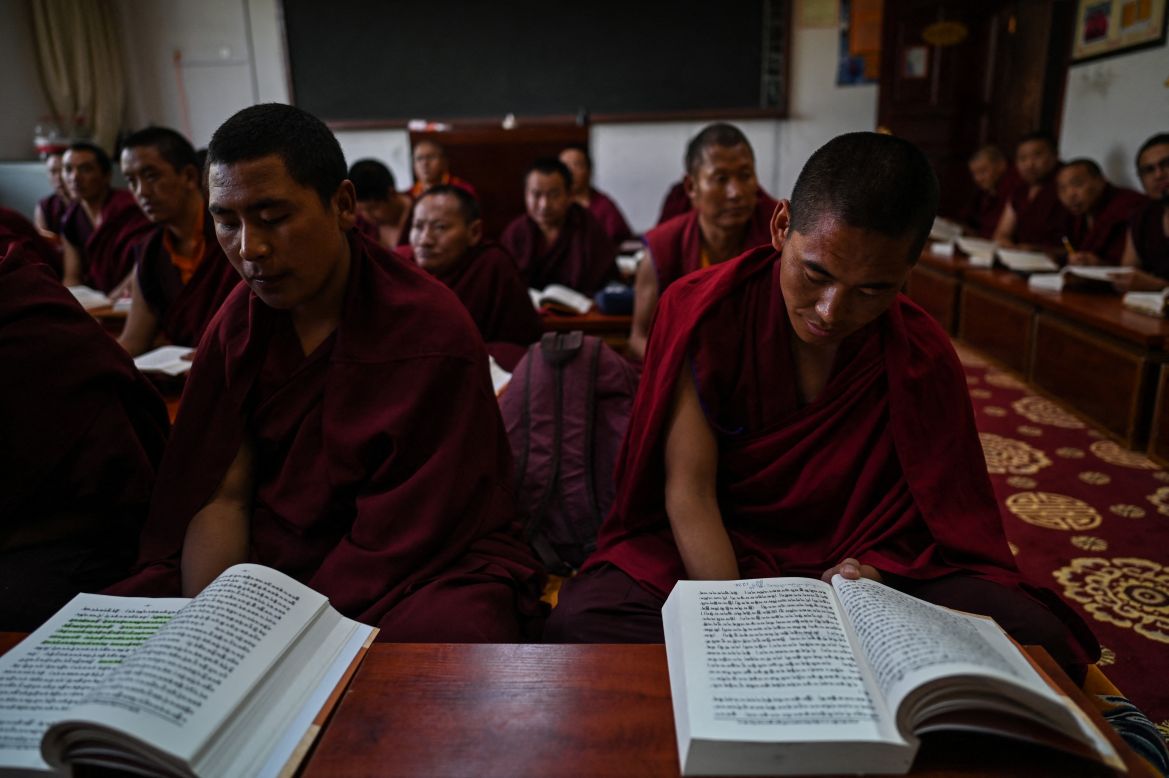
Monks, nuns and novices rehearsed religious texts, showed off their English and demonstrated traditional Buddhist debates, with the speaker delivering emphatic rhetorical flourishes in a pebbled courtyard.

“I have been here for more than two years,” said 32-year-old monk Xirekewang. “We study from 6am to around 9pm in the evening. I like studying here and don’t feel tired … the life is very good.”

But China has been accused of deliberately diluting Tibetan culture, including by directing its education system.

Critics say freedom of movement and expression is tightly controlled amid the continuing “Sinicisation” of the region.

Academics also say it has become extremely difficult to carry out studies of the region, making it harder to independently assess the quality of life on the ground.

“The levels of repression needed to keep a lid on things in Tibet … tells me that things continue to be tense there,” said Gray Tuttle, professor of modern Tibet studies at Columbia University.

The students were all smiles for foreign media at the well-funded Lhasa campus which boasts a new artificial turf football pitch and running track.

The vice president of the university, Gesang Wangdui, told the media the college’s success is down to China.

“I am a party member. I am not a Buddhist, I am a communist.”

Women in traditional costume standing in Potala Palace Square, near Potala Palace. [Hector Retamal/AFP]
Advertisement
The Potala Palace - classified as a World Heritage site by UNESCO in 1994 - in the regional capital, Lhasa. Beijing says it "peacefully liberated" the mountainous region of Tibet in 1951 and insists it has since brought infrastructure and education to a previously underdeveloped region. [Hector Retamal/AFP]
Monks studying at the Tibet Autonomous Region Buddhist College. [Hector Retamal/AFP]
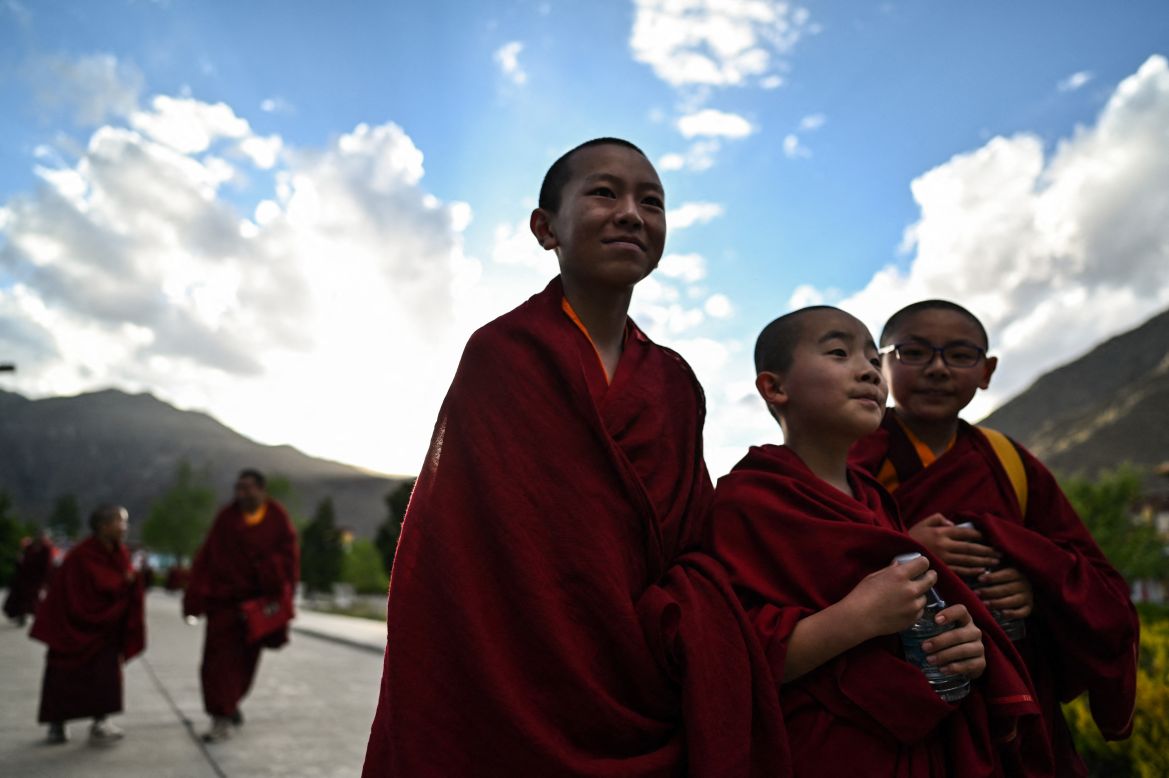
Monks take a walk after class at the Tibet Autonomous Region Buddhist College. Since 2008, it has been nearly impossible for journalists to visit Tibet except on organised trips. [Hector Retamal/AFP]
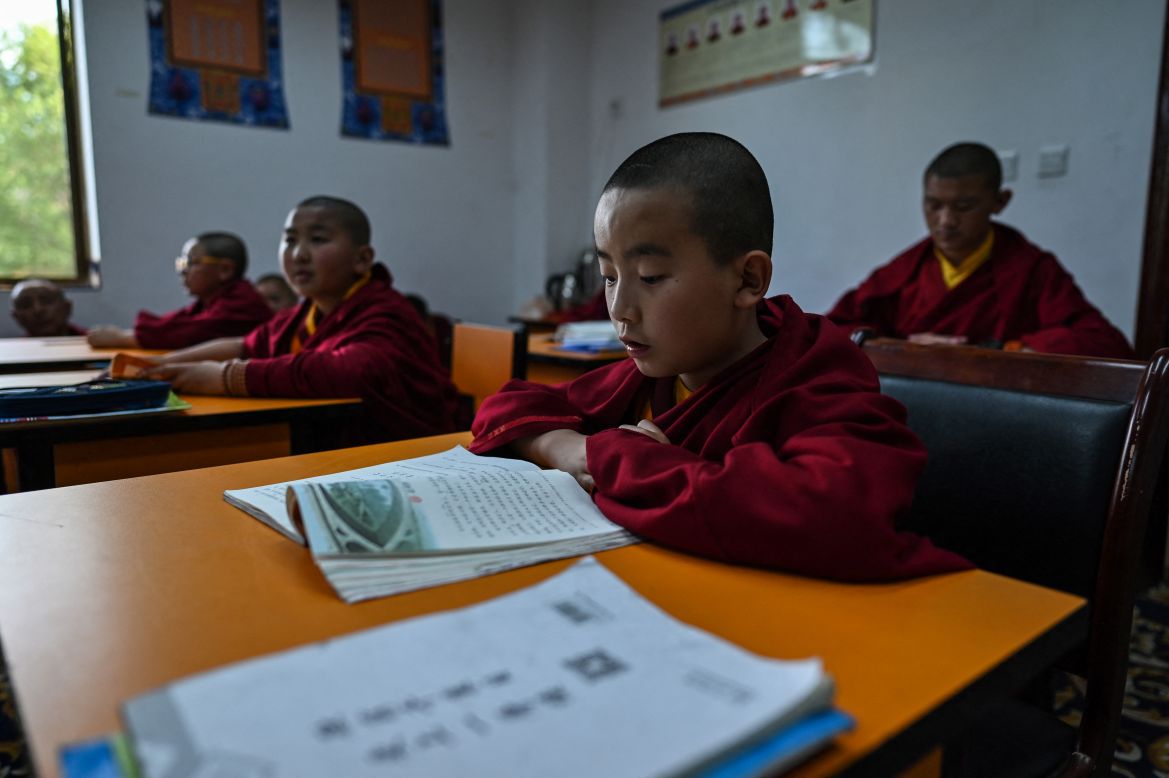
Young monks at the Tibet Autonomous Region Buddhist College. China has been accused of deliberately diluting Tibetan culture, including by directing its education system. [Hector Retamal/AFP]
Young monks studying at the Tibet Autonomous Region Buddhist College. Academics say it has become extremely difficult to carry out studies of the region, making it harder to independently assess the quality of life on the ground. [Hector Retamal/AFP]
Advertisement
College of Science graduates from Tibet University celebrate their graduation at the Potala Palace Square. [Hector Retamal/AFP]
College of Science graduates from Tibet University celebrate their graduation at the Potala Palace Square. Critics say freedom of movement and expression is tightly controlled amid an ongoing "Sinicisation" of the region. [Hector Retamal/AFP]
Monks at the Tibet Autonomous Region Buddhist College. The vice president of the university, Gesang Wangdui, told media the college's success is down to China. [Hector Retamal/AFP]

Related

  • China to build the world’s biggest dam on sacred Tibetan river

    The dam on the Yarlung Tsangpo is part of China’s ‘green’ initiatives but there are concerns about its effect.

    Published On 8 Feb 20218 Feb 2021
    The Yarlung Tsangpo River, more than 100 kilometres (62 miles) from Lhasa. Tibetans believe the river represents the body of the goddess Dorje Pagmo, one of the highest incarnations in Tibetan culture [File: Roman Pilipey/EPA]
  • India: Tibetans in exile vote to elect new political leader

    Tibet’s government-in-exile was formed in Dharamshala in 1959 after a failed uprising against the Chinese rule.

    Published On 3 Jan 20213 Jan 2021
    Tibet elections India
  • Tibetan spiritual leader Dalai Lama receives COVID vaccine

    The 85-year-old was inoculated with the Oxford-AstraZeneca vaccine and encouraged others to get vaccinated.

    Published On 6 Mar 20216 Mar 2021
    Tibetan spiritual leader, the Dalai Lama, receives a dose of coronavirus disease (COVID-19) vaccine at a vaccination centre in Dharamsala, India [Office of his holiness the Dalai Lama Handout via Reuters]
  • Xi says China to step up efforts to fight ‘splittism’ in Tibet

    Chinese leader tells senior Communist Party officials that Beijing must plant ‘seeds of loving China’ among Tibetans.

    Published On 30 Aug 202030 Aug 2020
    Tibet

More from Gallery

  • Photos: Manila’s streets empty as fuel prices surge amid Hormuz crisis

    A sharp increase in prices of basic commodities and the possible loss of employment for thousands of people due to the fuel price hike have raised the spectre of stagflation in the Philippines.
    This gallery article has 10 imagescamera10
  • Photos: More than one million displaced by Israel’s evacuations in Lebanon

    Over one million displaced by Israel’s evacuations in Lebanon
    This gallery article has 10 imagescamera10
  • Migrants march in southern Mexico to denounce immigration restrictions

    Migrants, some carrying children, walk on the highway through the municipality of Huehuetan, Chiapas state, Mexico, Wednesday, March 25, 2026, after leaving Tapachula the previous night. (AP Photo/Edgar H. Clemente)
    This gallery article has 9 imagescamera9
  • Photos: Iran fires new waves of missiles at Israel

    This picture shows damaged buildings at the site of an Iranian missile strike in Tel Aviv
    This gallery article has 8 imagescamera8

Most popular

  • Trump issues new 10-day deadline for attack on Iran energy infrastructure

    FILE PHOTO: Emergency personnel respond at a site following Iranian missile barrages in central Israel, amid the U.S.-Israel conflict with Iran, in Tel Aviv, Israel, March 24, 2026. REUTERS/Tomer Appelbaum ISRAEL OUT. NO COMMERCIAL OR EDITORIAL SALES IN ISRAEL/File Photo
  • Iran war updates: US, Israel attack ignites worst trade rupture in 80 years

    This handout image taken by the European Space Agency (ESA) captured by the Copernicus Sentinel-2 satellite shows a view of smoke plumes billowing in the vicinity Kuwait International Airport on March 25, 2026.
  • Tehran’s ‘toll booth’: How Iran picks who to let through Strait of Hormuz

    The Callisto tanker sits anchored in Port Sultan Qaboos as the traffic is down in the Strait of Hormuz
  • Trump’s signature to appear on US currency in first for sitting president

    Trump

  • About

    • About Us
    • Code of Ethics
    • Terms and Conditions
    • EU/EEA Regulatory Notice
    • Privacy Policy
    • Cookie Policy
    • Cookie Preferences
    • Accessibility Statement
    • Sitemap
    • Work for us
  • Connect

    • Contact Us
    • User Accounts Help
    • Advertise with us
    • Stay Connected
    • Newsletters
    • Channel Finder
    • TV Schedule
    • Podcasts
    • Submit a Tip
    • Paid Partner Content
  • Our Channels

    • Al Jazeera Arabic
    • Al Jazeera English
    • Al Jazeera Investigative Unit
    • Al Jazeera Mubasher
    • Al Jazeera Documentary
    • Al Jazeera Balkans
    • AJ+
  • Our Network

    • Al Jazeera Centre for Studies
    • Al Jazeera Media Institute
    • Learn Arabic
    • Al Jazeera Centre for Public Liberties & Human Rights
    • Al Jazeera Forum
    • Al Jazeera Hotel Partners

Follow Al Jazeera English:

  • facebook
  • twitter
  • youtube
  • instagram-colored-outline
  • rss
Al Jazeera Media Network logo
© 2026 Al Jazeera Media Network