Skip linksSkip to Content
play
Live
Navigation menu
  • News
    • Africa
    • Asia
    • US & Canada
    • Latin America
    • Europe
    • Asia Pacific
  • Middle East
  • Explained
  • Opinion
  • Sport
  • Video
    • Features
    • Economy
    • Human Rights
    • Climate Crisis
    • Investigations
    • Interactives
    • In Pictures
    • Science & Technology
    • Podcasts
    • Travel
play
Live

In Pictures

Gallery|Protests

In Pictures: Colombia protests sharpen Cali’s class war

At first, protesters saw the government as the enemy, but now they are facing wealthy, armed civilians.
Save

Share

facebooktwitterwhatsappcopylink
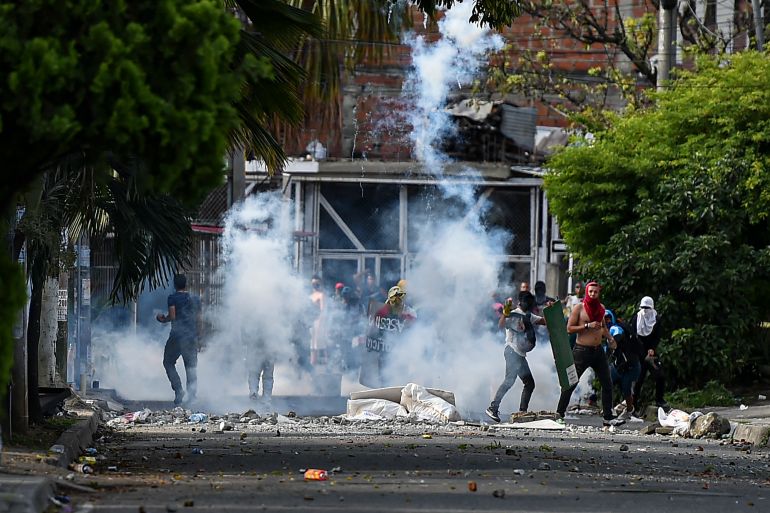
Demonstrators clash with riot police during a protest against the government of Colombian President Ivan Duque in Cali, Colombia. [Luis Robayo/AFP]
By AFP
Published On 22 Jun 202122 Jun 2021

In a rich neighbourhood in the Colombian city of Cali, residents standing next to police fire their weapons at protesters.

They believe they are protecting their possessions from the mob.

After 50 days of social protests against the government of right-wing President Ivan Duque, Cali’s class divide seems to be getting wider.

The southeastern city, well-known for its social inequality and racism, has been the epicentre of violent unrest during the protests.

On May 28, a mob from some of the nearby slums turned up in the affluent Ciudad Jardin neighbourhood and tried to burn down the police station.

Residents responded with gunfire.

“It was like a civil war with civilians worried for their homes and property, and the police on one side, and on the other side protesters… wanting to impose this anarchy and this chaos in our neighbourhood,” publicist Andres Escobar, 30, told AFP.

Escobar admits he fired his automatic pistol a few times “in the air” that day. It turned out to be the deadliest day of protests in the city, with 13 people killed.

That day was the most blatant example of “a conflict… marked by differences in class, differences in race and differences in ethnicity” that have been exacerbated by the pandemic, said Luis Castillo, a sociologist at the University of Valle in Cali.

With its luxury boutiques, mansions with swimming pools and palm tree-lined avenues, Ciudad Jardin resembles a mini Beverly Hills.

Almost none of the residents took to the streets to protest against Duque.

They also have not protested the widely condemned police brutality unleashed on demonstrators.

Advertisement

Those who first protested – initially against a now-withdrawn tax reform proposal – on April 28 were mostly unions and students demanding a change of government.

But for the first time, young Black and mixed-race people from poor neighbourhoods joined in.

In Cali, where the poverty rate of 67 per cent is much higher than the rest of the country, there is a clear “racial segregation”, said Castillo.

That helps explain why poor, Black neighbourhoods rose up after the pandemic hit the informal sector hard.

The protesters AFP spoke to were aged between 15 and 35, and either work in the informal sector, are unemployed or are students.

They are demanding jobs, education and health services.

Some cook and others draw outlines of dead companions on the floor, as they all listen to reggaeton and smoke to while away the hours.

They claim to have weapons but can only show homemade shields, sticks and stones.

These people are tired of “seeing families in misery”, said Plein, the coordinator of the “front line” at the Puerto Madera roadblock, who was shot during clashes with police.

“We want the rights that those with a bit of money have to be the same as the poor,” said Plein.

Inequality was worsening even before the pandemic struck, with 375,000 people falling into poverty between 2019 and 2020 out of the city's 2.2 million population. [Luis Robayo/AFP]
Advertisement
Aerial view of the south of Cali, Colombia. [Luis Robayo/AFP]
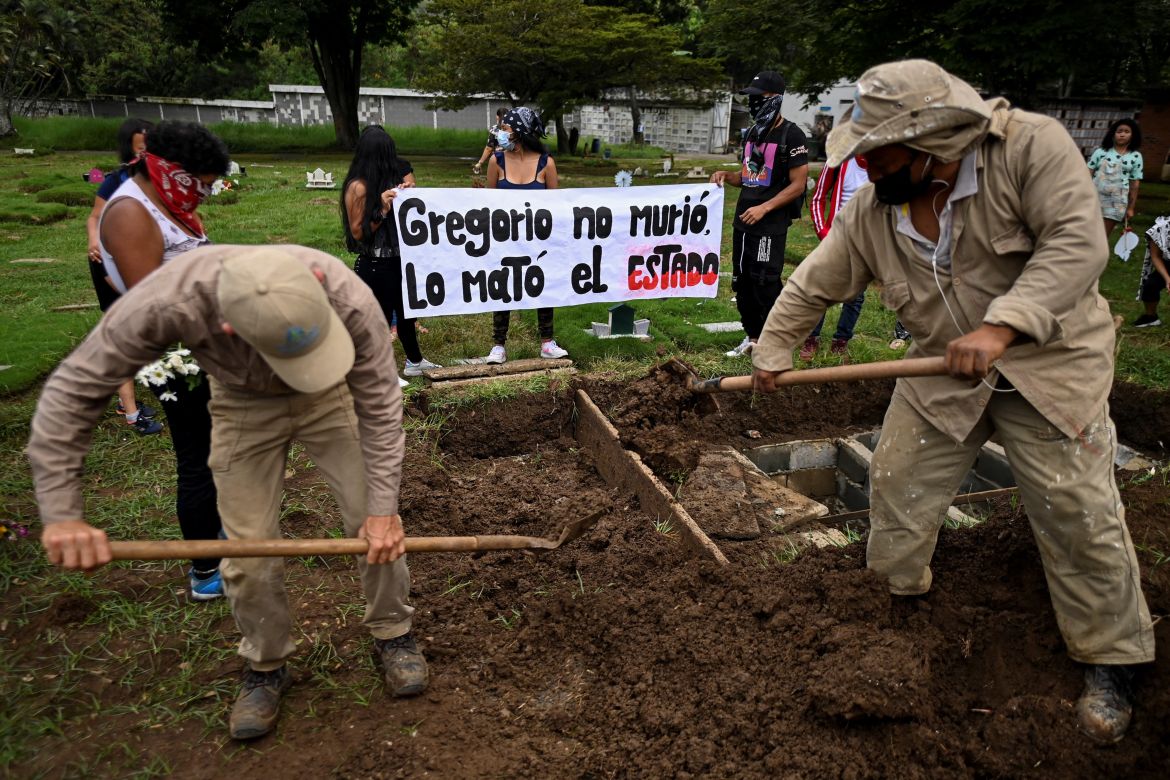
Two women cry during the funeral of Angelvis Gregorio Bello, a demonstrator who was found dead on a road between Cali and Palmira, in Cali. [Luis Robayo/AFP]
A burned bus is seen after a demonstration against the government of Colombian President Ivan Duque in Cali. [Luis Robayo/AFP]
A signal that reads "Territory of Peace" is seen during a protest against the government of Colombian President Ivan Duque in Cali. [Luis Robayo/AFP]
Aerial view of the east of Cali, Colombia. [Luis Robayo/AFP]
Advertisement
A signal that reads "Gregorio didn't die, the state killed him" is seen during the funeral of Angelvis Gregorio Bello, a demonstrator who was found dead on the road between Cali and Palmira, in Cali. [Luis Robayo/AFP]
With nothing to lose, these youths hunkered down behind roadblocks in urban camps, much to the chagrin of wealthier citizens as well as authorities. "We're talking about a (national) strike so... we have to make sure that nothing works," said the masked Cero, leader of the well-known Puerto Madera roadblock in the city. [Luis Robayo/AFP]
Indigenous people are transported on a Chiva (local bus) during a protest against the government of Colombian President Ivan Duque in Cali, Colombia. [Luis Robayo/AFP]

Related

  • From: NewsFeed

    Nepal’s new PM gives message to nation in rap, ahead of swearing in

    Nepali rapper-turned-politician Balendra Shah has been sworn in as PM after his party’s landslide election win.

    Published On 27 Mar 202627 Mar 2026
    Video Duration 01 minutes 12 seconds play-arrow01:12
  • From: NewsFeed

    Police fire water cannons at Chile student protest

    Police in Chile fired water cannons at students gathering in central Santiago to protest education policies.

    Published On 26 Mar 202626 Mar 2026
    .
    Video Duration 00 minutes 29 seconds play-arrow00:29
  • ‘Keffiyehs seized, left to die’: Inside the Palestine Action hunger strike

    Activists plan to take legal action against the UK prisons that allegedly mistreated them.

    Published On 25 Mar 202625 Mar 2026
    Twenty-four people were accused of breaking into Elbit Systems UK in August 2024, including, from left: Madeleine Norman, Teuta Hoxha, Heba Muraisi, Qesser Zuhrah, and Kamran Ahmed [Anealla Safdar/Al Jazeera]
  • From: NewsFeed

    Thousands march to mark 50th anniversary of Argentina’s bloody coup

    Thousands of people took to the streets in Buenos Aires to mark the 50th anniversary of Argentina’s last military coup.

    Published On 25 Mar 202625 Mar 2026
    Video Duration 01 minutes 42 seconds play-arrow01:42

More from Gallery

  • Photos: Manila’s streets empty as fuel prices surge amid Hormuz crisis

    A sharp increase in prices of basic commodities and the possible loss of employment for thousands of people due to the fuel price hike have raised the spectre of stagflation in the Philippines.
    This gallery article has 10 imagescamera10
  • Photos: More than one million displaced by Israel’s evacuations in Lebanon

    Over one million displaced by Israel’s evacuations in Lebanon
    This gallery article has 10 imagescamera10
  • Migrants march in southern Mexico to denounce immigration restrictions

    Migrants, some carrying children, walk on the highway through the municipality of Huehuetan, Chiapas state, Mexico, Wednesday, March 25, 2026, after leaving Tapachula the previous night. (AP Photo/Edgar H. Clemente)
    This gallery article has 9 imagescamera9
  • Photos: Iran fires new waves of missiles at Israel

    This picture shows damaged buildings at the site of an Iranian missile strike in Tel Aviv
    This gallery article has 8 imagescamera8

Most popular

  • Israel vows no let-up in Iran attacks despite US push to end war

    TOPSHOT - This video grab taken from images released by the Iranian state broadcaster (IRIB) on March 26, 2026, shows what it says is the second phase of the 82nd wave of missiles launched against Israel and US bases in the United Arab Emirates and Kuwait.
  • How extensive is Russia’s military aid to Iran?

    Iranian missile strikes
  • Saudi, UAE, Iraq: Can three pipelines help oil escape Strait of Hormuz?

    TOPSHOT - Indian vessel 'Nanda Devi' carrying liquefied petroleum gas (LPG) arrives at Vadinar Port in the Jamnagar district of Gujarat state on March 17, 2026 after Iran allowed it to pass through the Strait of Hormuz, a key energy corridor that remains disrupted by the Middle East war.
  • ‘Raising 10 red flags’: Is Israel’s army exhausted?

    Israeli soldiers

  • About

    • About Us
    • Code of Ethics
    • Terms and Conditions
    • EU/EEA Regulatory Notice
    • Privacy Policy
    • Cookie Policy
    • Cookie Preferences
    • Accessibility Statement
    • Sitemap
    • Work for us
  • Connect

    • Contact Us
    • User Accounts Help
    • Advertise with us
    • Stay Connected
    • Newsletters
    • Channel Finder
    • TV Schedule
    • Podcasts
    • Submit a Tip
    • Paid Partner Content
  • Our Channels

    • Al Jazeera Arabic
    • Al Jazeera English
    • Al Jazeera Investigative Unit
    • Al Jazeera Mubasher
    • Al Jazeera Documentary
    • Al Jazeera Balkans
    • AJ+
  • Our Network

    • Al Jazeera Centre for Studies
    • Al Jazeera Media Institute
    • Learn Arabic
    • Al Jazeera Centre for Public Liberties & Human Rights
    • Al Jazeera Forum
    • Al Jazeera Hotel Partners

Follow Al Jazeera English:

  • facebook
  • twitter
  • youtube
  • instagram-colored-outline
  • rss
Al Jazeera Media Network logo
© 2026 Al Jazeera Media Network