Skip linksSkip to Content
play
Live
Navigation menu
  • News
    • Africa
    • Asia
    • US & Canada
    • Latin America
    • Europe
    • Asia Pacific
  • Middle East
  • Explained
  • Opinion
  • Sport
  • Video
    • Features
    • Economy
    • Human Rights
    • Climate Crisis
    • Investigations
    • Interactives
    • In Pictures
    • Science & Technology
    • Podcasts
    • Travel
play
Live

In Pictures

Gallery|Space

NASA’s new moon rocket lifts off, 50 years after Apollo

The liftoff marks the start of NASA’s Artemis lunar-exploration programme.
Save

Share

facebooktwitterwhatsappcopylink
US-SPACE-MOON-ARTEMIS
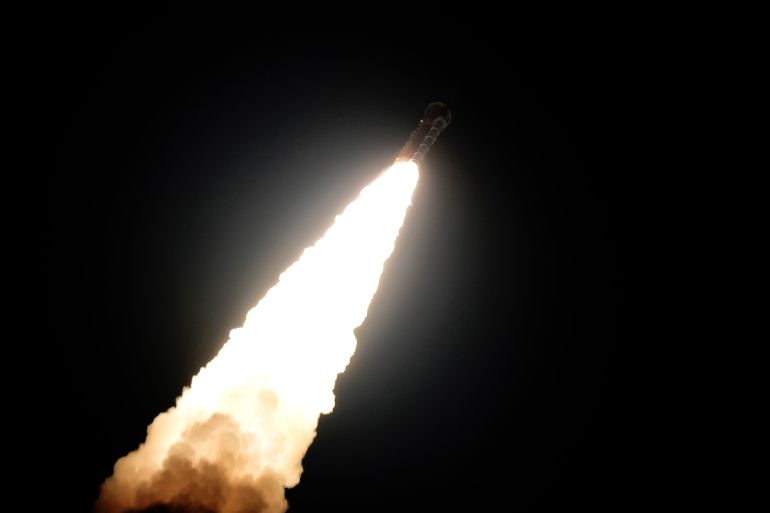
NASA's new moon rocket lifts off from Kennedy Space Center's Launch Pad 39-B in Cape Canaveral, Florida, the United States. [Chris O'Meara/AP Photo]
By News Agencies
Published On 16 Nov 202216 Nov 2022

NASA’s new moon rocket blasted off on its debut flight with three test dummies on board early on Wednesday, bringing the United States a big step closer to putting astronauts back on the moon for the first time since the end of the Apollo programme 50 years ago.

If all goes well during the three-week flight, the rocket will propel an empty crew capsule into a wide orbit around the moon, and then the capsule will return to Earth with a splashdown in the Pacific in December.

After years of delays and billions in cost overruns, the Space Launch System rocket thundered skyward, rising from Kennedy Space Center on 4 million kilograms (8.8 million pounds) of thrust and hitting 160km/h (100 mph) within seconds. The Orion capsule was perched on top, ready to bust out of Earth orbit towards the moon not quite two hours into the flight.

The moonshot follows nearly three months of vexing fuel leaks that kept the rocket bouncing between its hangar and the pad. Forced back indoors by Hurricane Ian at the end of September, the rocket remained outside as Nicole swept through last week with gusts of more than 130km/h (80 mph). Although the wind peeled away a 3-metre (10-foot) strip of caulking high up near the capsule, managers gave the green light for the launch.

The liftoff marked the start of NASA’s Artemis lunar exploration programme, named after Apollo’s mythological twin sister. The space agency is aiming to send four astronauts around the moon on the next flight, in 2024, and land humans there as early as 2025.

Advertisement

The 98-metre (322-foot) SLS is the most powerful rocket ever built by NASA, with more thrust than either the space shuttle or the mighty Saturn V that carried men to the moon.

Orion should reach the moon by Monday, more than 370,000km (230,000 miles) from Earth. After coming within 130km (80 miles) of the moon, the capsule will enter a far-flung orbit stretching about 64,000km (40,000 miles) beyond.

The $4.1bn test flight is expected to last 25 days, roughly the same as when crews will be on board. The space agency intends to push the spacecraft to its limits and uncover any problems before astronauts strap in. The mannequins – NASA calls them moonequins – are fitted with sensors to measure such things as vibration, acceleration and cosmic radiation.

The rocket was supposed to have made its dry run by 2017. Government watchdogs estimate NASA will have spent $93bn on the project by 2025.

Ultimately, NASA hopes to establish a base on the moon and send astronauts to Mars by the late 2030s or early 2040s.

US-SPACE-MOON-ARTEMIS
NASA's new moon rocket is seen at Launch Pad 39B during the preparations for launch at the Kennedy Space Center in Cape Canaveral, Florida. [Terry Renna/AP Photo]
Advertisement
US-SPACE-MOON-ARTEMIS
Guests at the Banana Creek viewing site wait for the launch of NASA's Space Launch System (SLS) rocket carrying the Orion spacecraft on the Artemis I flight test, at NASA's Kennedy Space Center in Florida. [Keegan Barber/NASA via AP]
US-SPACE-MOON-ARTEMIS
NASA's next-generation moon rocket, the SLS rocket with the Orion crew capsule, lifts off from launch complex 39-B on the uncrewed Artemis1 mission to the moon at Cape Canaveral. [Thom Baur/Reuters]
US-SPACE-MOON-ARTEMIS
The Artemis I uncrewed lunar rocket lifts off from launch pad 39B at NASA's Kennedy Space Center in Cape Canaveral. [Photo by Gregg Newton / AFP]
US-SPACE-MOON-ARTEMIS
People at Veterans Memorial park watch as the Artemis I uncrewed lunar rocket lifts off. [Marco Bello / AFP]
US-SPACE-MOON-ARTEMIS
The test flight is expected to last 25 days, roughly the same as when crews will be on board. [John Raoux/AP Photo]
Advertisement
US-SPACE-MOON-ARTEMIS
People at Veterans Memorial park watch as the Artemis I uncrewed lunar rocket lifts off. [Marco Bello / AFP]
US-SPACE-MOON-ARTEMIS
Cheers accompanied the rocket as it rode a huge trail of flame toward space.[NASA/Getty Images via AFP]
US-SPACE-MOON-ARTEMIS
Orion should reach the moon by Monday, more than 370,000km (230,000 miles) from Earth. [Marco Belllo / AFP]
US-SPACE-MOON-ARTEMIS
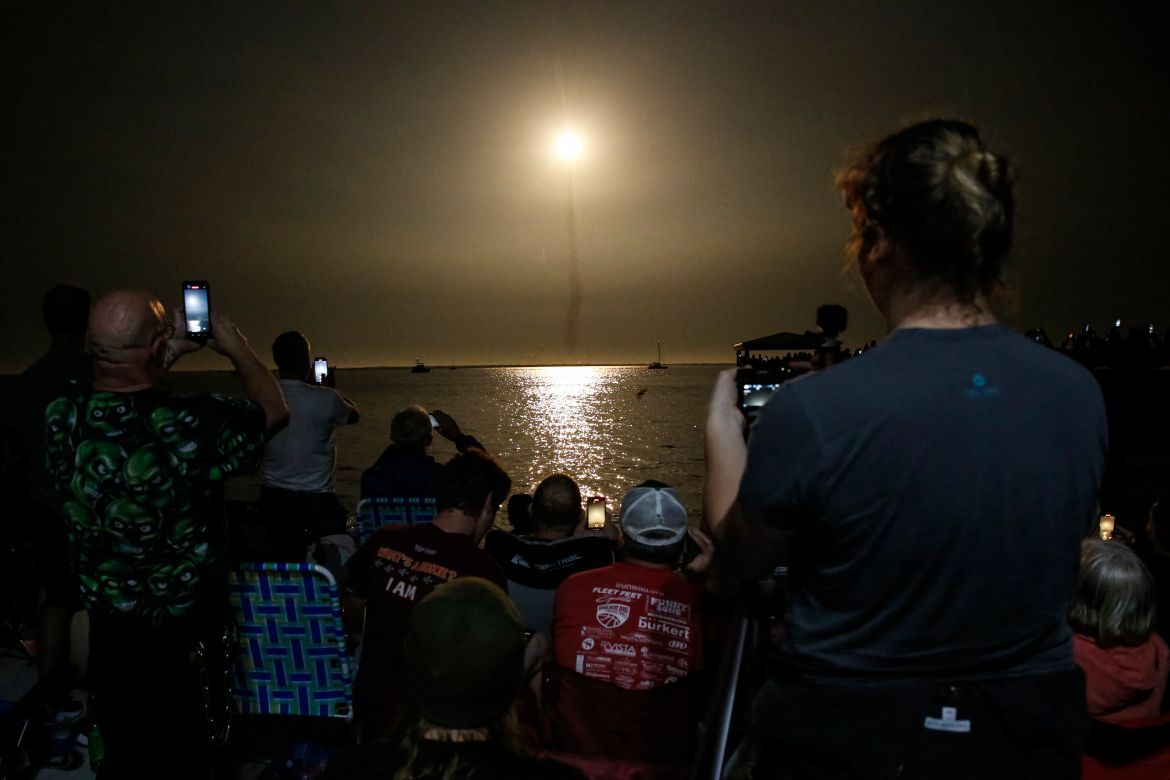
During the launch, a half-moon glowed brightly and buildings shook as though hit by a major quake. "For the Artemis generation, this is for you," launch director Charlie Blackwell-Thompson called out, referring to all those born after Apollo. [Jim Watson/ AFP]

Related

  • Artemis lift-off: NASA successfully launches massive moon rocket

    The moonshot follows nearly three months of vexing fuel leaks that kept the rocket grounded.

    Published On 16 Nov 202216 Nov 2022
    NASA's new moon rocket lifts off from Kennedy Space Center's Launch Pad 39-B on Wednesday in Cape Canaveral, Florida [John Raoux/AP]
  • Fuel leak ruins NASA’s second attempt at launching moon rocket

    Fuel leak ruins NASA’s second bid at launching the SLS, delaying the debut of its moon-to-Mars mission by weeks.

    Published On 3 Sep 20223 Sep 2022
    NASA's next-generation moon rocket, the Space Launch System (SLS), with the Orion crew capsule, is seen on launch complex 39B after its launch on the Artemis 1 mission was delayed, at Cape Canaveral, Florida, U.S. September 3, 2022.
  • NASA aims to launch new Artemis moon rocket on Saturday

    Fuel leaks and a bad engine sensor foiled Monday’s attempt, managers say they have now addressed the problems.

    Published On 2 Sep 20222 Sep 2022
    Moon rocket
  • Why was NASA’s Artemis 1 launch scrubbed and what’s next?

    The next launch opportunity is on Friday but it depends on the ‘outcome of troubleshooting on the engine bleed issue’.

    Published On 29 Aug 202229 Aug 2022
    News media members react as NASA's next-generation moon rocket, the Space Launch System (SLS) , with its Orion crew capsule on top, sits on the pad after the launch of the Artemis I mission was scrubbed, at Cape Canaveral, Florida, U.S.,

More from Gallery

  • Photos: Manila’s streets empty as fuel prices surge amid Hormuz crisis

    A sharp increase in prices of basic commodities and the possible loss of employment for thousands of people due to the fuel price hike have raised the spectre of stagflation in the Philippines.
    This gallery article has 10 imagescamera10
  • Photos: More than one million displaced by Israel’s evacuations in Lebanon

    Over one million displaced by Israel’s evacuations in Lebanon
    This gallery article has 10 imagescamera10
  • Migrants march in southern Mexico to denounce immigration restrictions

    Migrants, some carrying children, walk on the highway through the municipality of Huehuetan, Chiapas state, Mexico, Wednesday, March 25, 2026, after leaving Tapachula the previous night. (AP Photo/Edgar H. Clemente)
    This gallery article has 9 imagescamera9
  • Photos: Iran fires new waves of missiles at Israel

    This picture shows damaged buildings at the site of an Iranian missile strike in Tel Aviv
    This gallery article has 8 imagescamera8

Most popular

  • Israel vows no let-up in Iran attacks despite US push to end war

    TOPSHOT - This video grab taken from images released by the Iranian state broadcaster (IRIB) on March 26, 2026, shows what it says is the second phase of the 82nd wave of missiles launched against Israel and US bases in the United Arab Emirates and Kuwait.
  • Saudi, UAE, Iraq: Can three pipelines help oil escape Strait of Hormuz?

    TOPSHOT - Indian vessel 'Nanda Devi' carrying liquefied petroleum gas (LPG) arrives at Vadinar Port in the Jamnagar district of Gujarat state on March 17, 2026 after Iran allowed it to pass through the Strait of Hormuz, a key energy corridor that remains disrupted by the Middle East war.
  • How extensive is Russia’s military aid to Iran?

    Iranian missile strikes
  • ‘Raising 10 red flags’: Is Israel’s army exhausted?

    Israeli soldiers

  • About

    • About Us
    • Code of Ethics
    • Terms and Conditions
    • EU/EEA Regulatory Notice
    • Privacy Policy
    • Cookie Policy
    • Cookie Preferences
    • Accessibility Statement
    • Sitemap
    • Work for us
  • Connect

    • Contact Us
    • User Accounts Help
    • Advertise with us
    • Stay Connected
    • Newsletters
    • Channel Finder
    • TV Schedule
    • Podcasts
    • Submit a Tip
    • Paid Partner Content
  • Our Channels

    • Al Jazeera Arabic
    • Al Jazeera English
    • Al Jazeera Investigative Unit
    • Al Jazeera Mubasher
    • Al Jazeera Documentary
    • Al Jazeera Balkans
    • AJ+
  • Our Network

    • Al Jazeera Centre for Studies
    • Al Jazeera Media Institute
    • Learn Arabic
    • Al Jazeera Centre for Public Liberties & Human Rights
    • Al Jazeera Forum
    • Al Jazeera Hotel Partners

Follow Al Jazeera English:

  • facebook
  • twitter
  • youtube
  • instagram-colored-outline
  • rss
Al Jazeera Media Network logo
© 2026 Al Jazeera Media Network