Skip linksSkip to Content
play
Live
Navigation menu
  • News
    • Africa
    • Asia
    • US & Canada
    • Latin America
    • Europe
    • Asia Pacific
  • Middle East
  • Explained
  • Opinion
  • Sport
  • Video
    • Features
    • Economy
    • Human Rights
    • Climate Crisis
    • Investigations
    • Interactives
    • In Pictures
    • Science & Technology
    • Podcasts
    • Travel
play
Live
Navigation menu
  • Iran
  • Iran’s ‘axis’ in disarray
  • Will Gulf states join war?
  • Iran’s weapons
  • Who's in charge in Iran?

In Pictures

Gallery|In Pictures

Photos: The troubled history of Iran-US relations

The United States broke off diplomatic relations with Iran in 1980, but the enmity started decades earlier.
Save

Share

facebooktwitterwhatsappcopylink
Iran US timeline
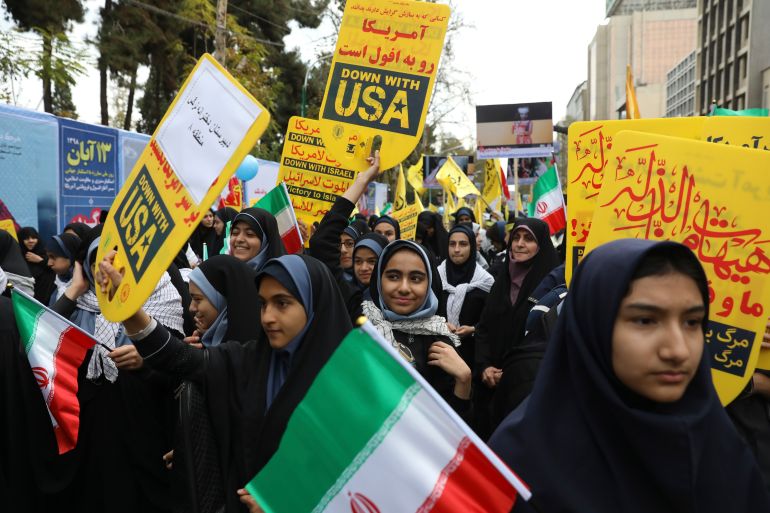
Schoolgirls hold national flags along with anti-US placards at the annual rally in front of the former US Embassy in Tehran, Iran on November 4, 2019 - the 40th anniversary of the 1979 student takeover of the US Embassy in Tehran and the 444-day hostage crisis that followed [File: Vahid Salemi/AP]
Published On 29 Nov 202229 Nov 2022

Iran and the United States have a checkered political history going back decades.

Iran has long accused the US of meddling in its internal affairs. In 1953, the US intelligence agency the CIA, with help from the United Kingdom, backed a coup that ousted Iran’s first democratically-elected Prime Minister Mohammad Mossadegh after he tried to nationalise the country’s oil industry.

The coup brought back to power a Western-backed monarch, Shah Mohammad Reza Pahlavi, and for a time the US and Iran were Cold War allies.

In 1957, the two countries signed a cooperation agreement for the civilian use of nuclear power, part of then-US President Dwight D Eisenhower’s “Atoms for Peace” programme. A decade later, the US provided Iran with a nuclear reactor and uranium to fuel it. The nuclear collaboration would continue for another 12 years.

In 1972, then-US President Richard Nixon visited the capital, Tehran. But while relations between the US government and Iran’s rulers flourished, ordinary Iranians suffered under a corrupt elite and increasingly dictatorial ruler.

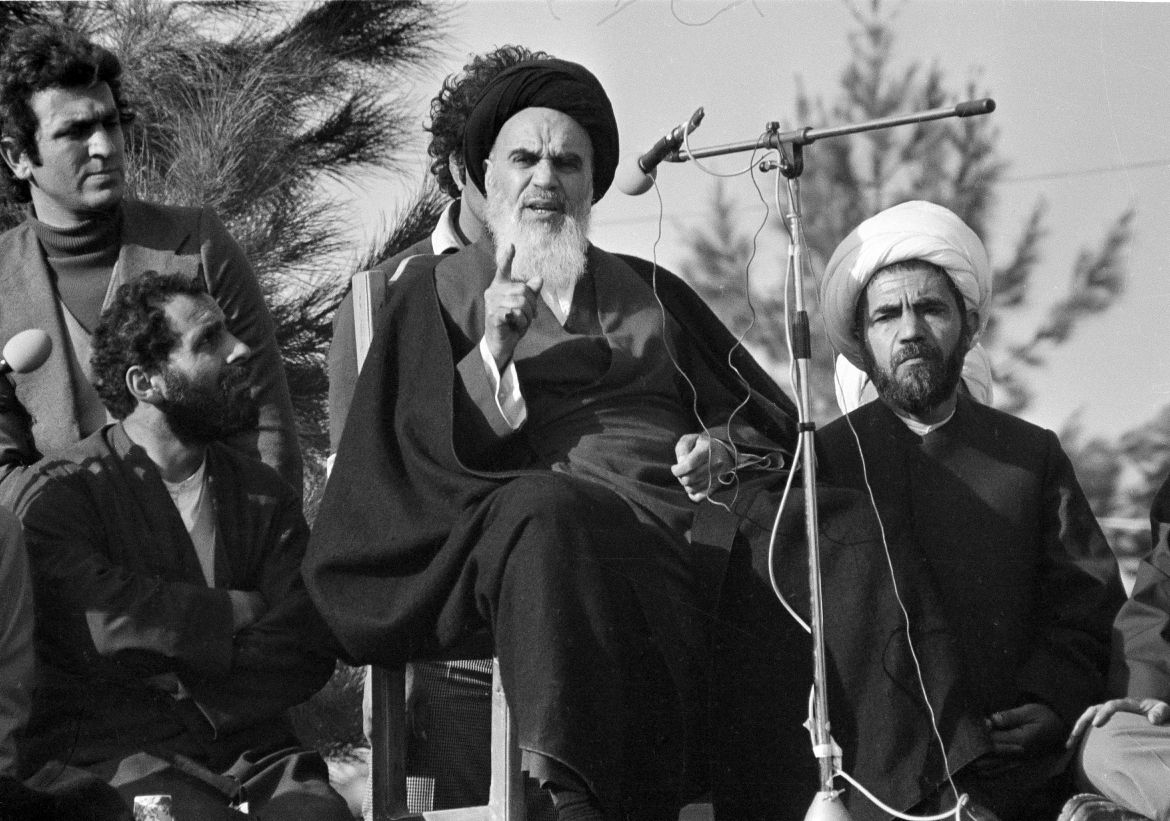
The resulting civil unrest led to the 1979 Islamic Revolution in Iran. Pahlavi was overthrown and eventually took refuge in the US. The revolution’s leader, Ayatollah Ruhollah Khomeini, formed a new republic and turned the country’s focus away from the West.

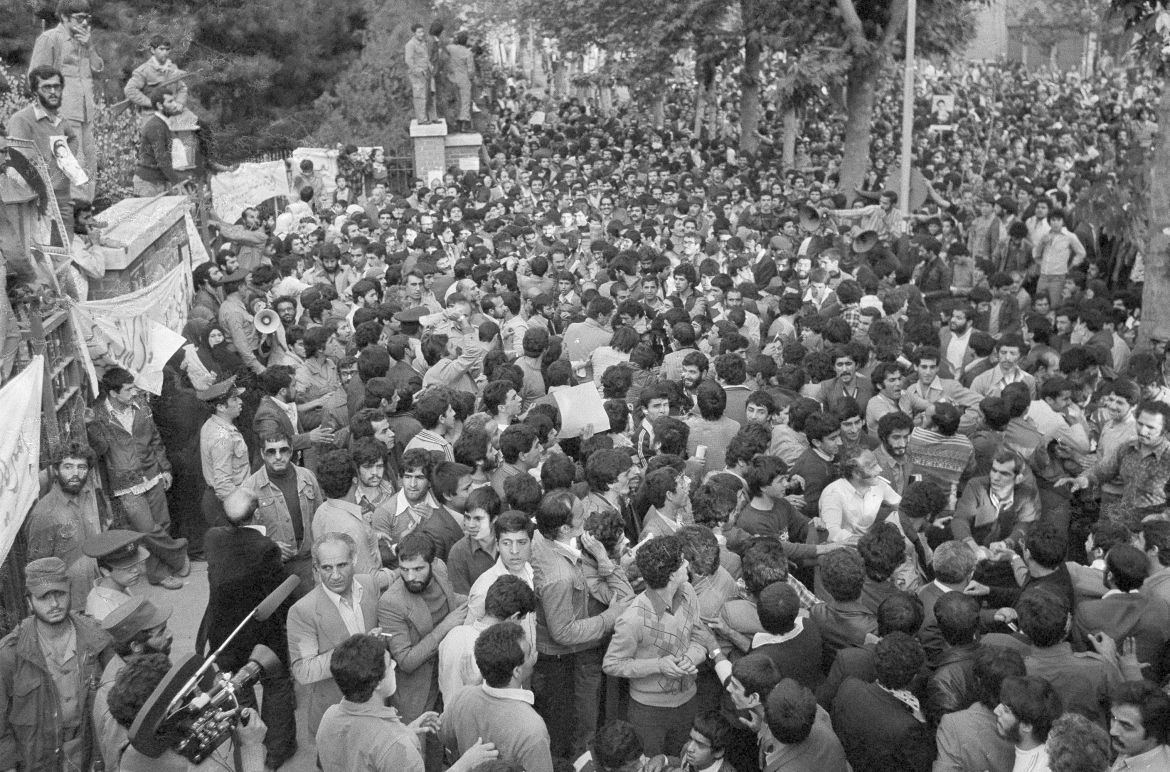
Later that year, Iranian students supporting the revolution overran the US Embassy in Tehran, taking 52 Americans hostage and holding them for 444 days.

In April 1980, the US cut off diplomatic ties with Iran.

Advertisement

It also backed Iraq in the 1980-1988 Iran-Iraq war that killed hundreds of thousands on both sides.

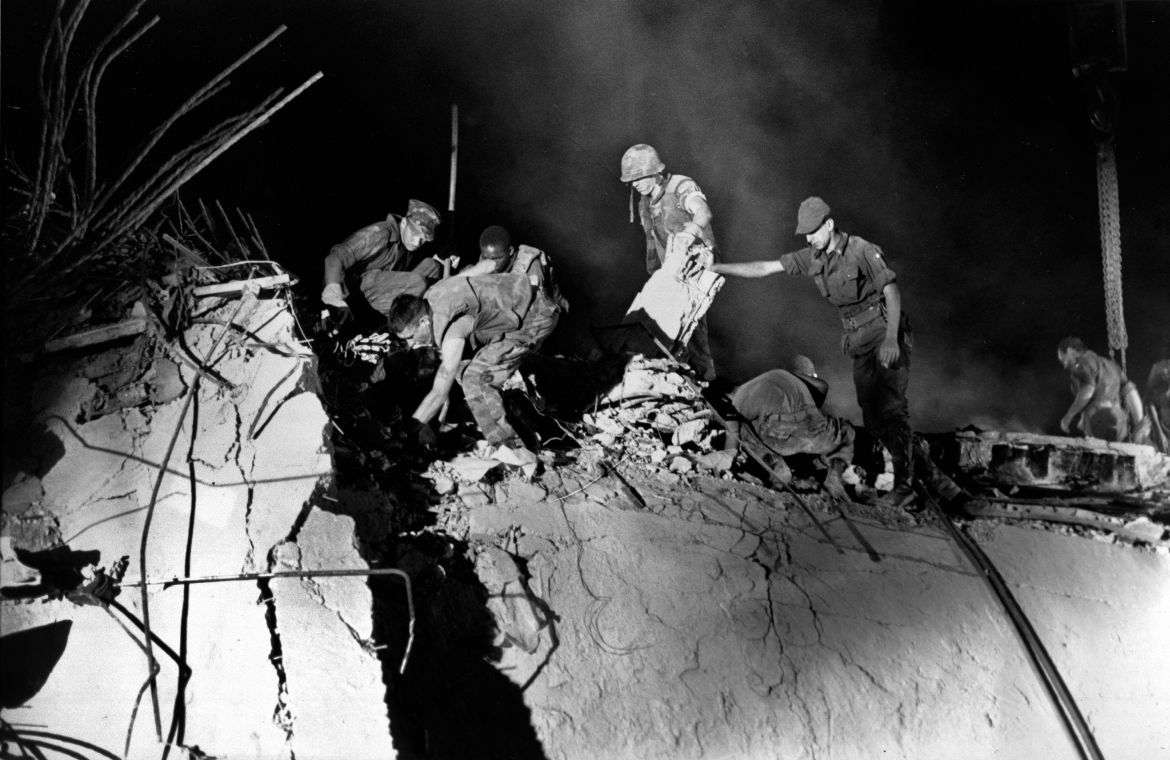
When an attack on a multinational military base in Beirut, Lebanon killed 241 US service members in 1983, the US blamed Hezbollah, a Lebanese Shia party backed by Iran.

The following year, the US added Iran to its “State Sponsors of Terrorism” list.

In 1988, the US Navy shot down an Iranian civilian plane. All 290 people onboard were killed.

In the early 1990s, the US escalated sanctions against Iran, seeking to keep it from getting advanced weaponry.

A brief thaw in ties occurred in 1998, when then-US Secretary of State Madeleine Albright met with Iran’s deputy foreign minister and other diplomats at the United Nations in the highest-level encounter since 1979, though there were no direct talks.

In 2002, following the September 11 attacks on New York City and Washington, DC, then-US President George W Bush described Iran as being part of the “Axis of Evil” – alongside North Korea and Iraq.

When it emerged that Iran was developing its nuclear programme in the early 2000s, Washington led efforts to have the international community impose sanctions, despite Tehran maintaining it was not seeking a nuclear weapon.

Then US-President Barack Obama agreed to talks with Iran with other nations present, paving the way for the 2015 nuclear deal that would limit Iran’s nuclear activities in exchange for an easing of sanctions.

Under President Donald Trump, the US unilaterally withdrew from the deal in 2018, restoring sanctions against Iran. Iran began producing enriched uranium, beyond the limits the deal had imposed.

In January 2020, tensions were further heightened when the US killed Iranian General Qassem Soleimani, the head of Iran’s Islamic Revolutionary Guard Corps’ (IRGC’s) Quds Force, in a drone strike in Baghdad, Iraq.

In 2021, US President Joe Biden promised to revive the nuclear deal with Iran, but after several rounds of talks, the deal remains in jeopardy.

More recently, the US has accused Iran of supplying Russia with drones in its war with Ukraine.

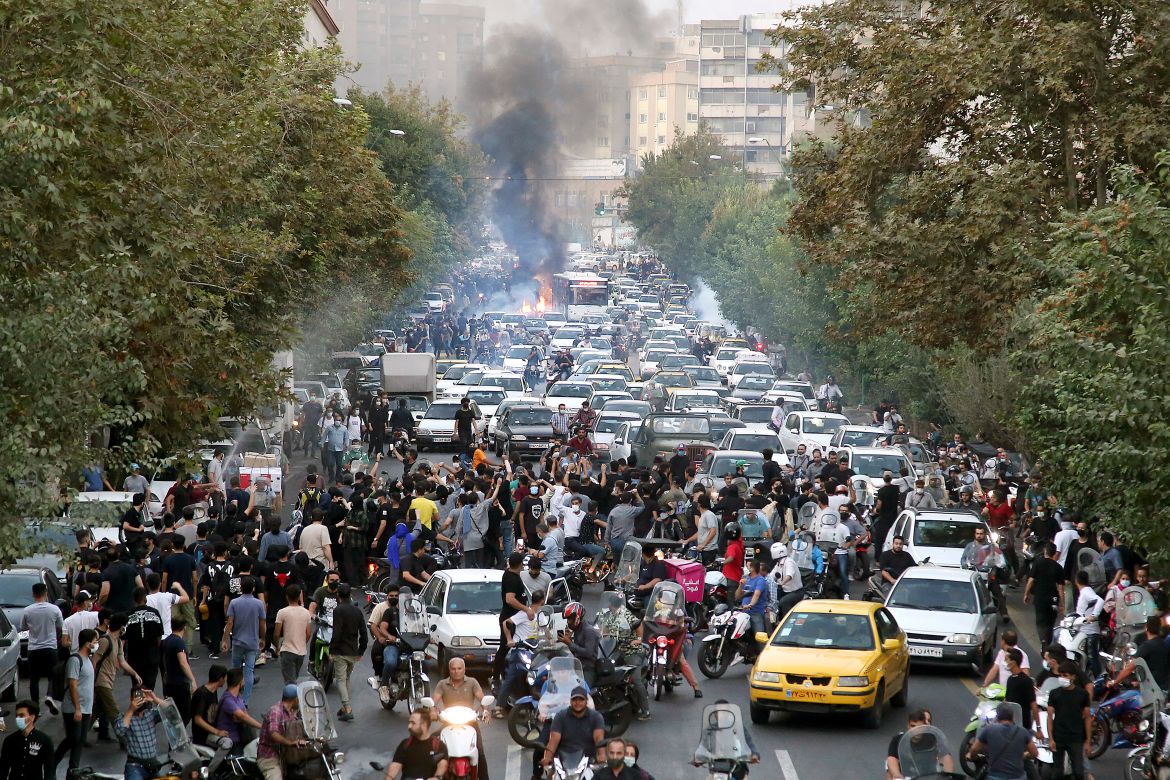
Earlier this month, the US sanctioned Iranian officials, accusing them of complicity in human rights violations in the wake of widespread protests sparked by the death in police custody of 22-year-old Mahsa Amini, an Iranian woman detained by the country’s morality police in September.

Iran US timeline
In this September 27, 1951 photo, Prime Minister Mohammad Mossadegh rides on the shoulders of cheering crowds in Tehran's Majlis Square, outside the parliament building, after reiterating his oil nationalisation views to his supporters - he would be overthrown in a US-backed coup in 1953. [AP Photo]
Advertisement
Iran US timeline
In this January 16, 1979 photo, Shah Mohammad Reza Pahlavi and Empress Farah walk on the tarmac at Mehrabad Airport in Tehran to board a plane to leave the country for the last time after the revolution overthrew the vestiges of Pahlavi's caretaker government. [AP Photo]
Iran US timeline
The leader of Iran's revolution, Ayatollah Ruhollah Khomeini, speaks to followers at Behesht-e Zahra Cemetery after his arrival in Tehran ending 14 years of exile on February 1, 1979. [AP Photo]
Iran US timeline
A mass of Iranian protesters is held back from the gates of the US Embassy in Tehran on November 5, 1979 - a day after Iranian students overran guards to take over the embassy, starting a 444-day hostage crisis that transfixed America. [AP Photo]
Iran US timeline
In this November 8, 1979 photo, one of the hostages held at the US Embassy in Tehran is shown to the crowd by Iranian students. [AP Photo]
Iran US timeline
In this December 12, 1979 photo, a new sign appears at the US Embassy compound in Tehran, warning that "Iran will bury you." [Mohammad Sayad/AP Photo]
Advertisement
Iran US timeline
In this October 24, 1983 photo, US Marines and an Italian soldier, right, search through the rubble of the battalion headquarters in Beirut, Lebanon after a suicide car bomb attack against the US Marine barracks that killed more than 240 US service members. [File: Bill Foley/AP Photo]
Iran US timeline
Iranian and US football fans, faces painted with the colours of their national flags, shout together before the 1998 Iran vs US World Cup match in Lyon, France. That meeting between Iran and the US, bitter political enemies for almost 20 years, was the most politically sensitive match of the competition. Iran won 2-1. [Reuters]
Iran US timeline
Then-Iranian President Mohammad Khatami, right, visits the Natanz uranium enrichment facilities, some 124 km (200 miles) south of Tehran on March 30, 2005. In August 2002, western intelligence services and an Iranian opposition group had revealed Iran's secret Natanz nuclear enrichment facility. [Vahid Salemi/AP Photo]
Iran US timeline
Deputy parliament speaker Mohammad-Hassan Aboutorabi Fard, centre, talks to lawmakers following a debate in Tehran on August 28, 2013 after parliament approved the outlines of a bill requiring the government to sue the US for its involvement in the 1953 coup that overthrew the country's democratically elected prime minister. A suit has not been filed. [Ebrahim Noroozi/AP Photo]
Iran US timeline
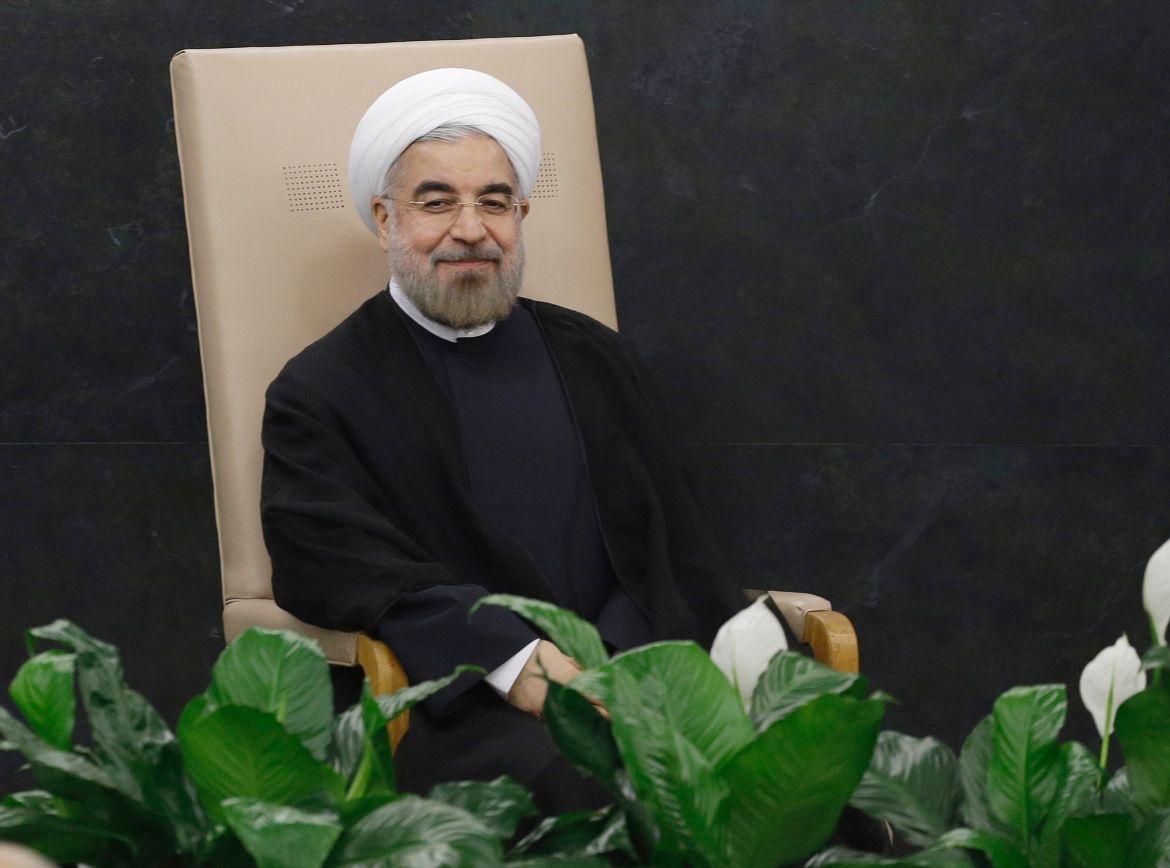
In this September 24, 2013 photo, Iranian President Hassan Rouhani prepares to address the 68th session of the United Nations General Assembly, at UN headquarters in New York City. Two years later, he would agree to a nuclear deal with the US, the United Kingdom, Russia, France, and China, Germany and the European Union. [Frank Franklin II/AP Photo]
Iran US timeline
Demonstrators burn a picture of US President Donald Trump during a protest in front of the former US Embassy in Tehran on May 9, 2018, in response to Trump's decision to pull out of the international nuclear deal and renew sanctions. [Vahid Salemi/AP Photo]
Mourners carry the coffin of Qassem Soleimani on January 4, 2020
Mourners carry the coffins of Iran's General Qassem Soleimani and Abu Mahdi al-Muhandis, deputy commander of Iran-backed militias in Iraq known as the Popular Mobilisation Forces, during their funeral in the shrine of Imam Hussain in Karbala, Iraq on January 4, 2020. Iran vowed "harsh retaliation" for the US air strike near Baghdad's airport that killed Tehran's top general. [Khalid Mohammed/AP Photo]
Iran US timeline
A man holds a picture of late Iranian General Qassem Soleimani as people celebrate in the street after Iran launched missiles at US-led forces in Iraq, in Tehran on January 8, 2020. [Nazanin Tabatabaee/West Asia News Agency via Reuters]
Iran US timeline
In this January 13, 2020 photo, US soldiers stand at the spot hit by Iranian bombing at Ain al-Asad air base, in Anbar, Iraq - part of a bombardment done in retaliation for the US drone strike that killed top Iranian commander Soleimani. [Qassim Abdul-Zahra/AP Photo]
Iran US timeline
Protesters chant slogans during a demonstration in response to the death of a woman who was detained by morality police for wearing "improper" attire, in downtown Tehran on September 21, 2022. [AP Photo]

Related

  • Fans say Iran vs USA game an opportunity for ‘stronger bonds’

    For two fans at the World Cup, football is a reminder that individuals are more than the countries they come from.

    Published On 29 Nov 202229 Nov 2022
    Tuesday's match between Iran and the United States, bitter enemies for decades, is the most politically sensitive match of the competition [File: Reuters]
  • World Cup 2022 updates: Senegal fans celebrate team’s progression

    All the updates from November 29, as they happened.

    Published On 29 Nov 202229 Nov 2022
    Senegal fans celebrating their victory over host-nation Qatar on November 25, 2022.
  • Ongoing protests cast shadow over World Cup for Iranian Americans

    Protests against the Iranian government following the death of 22-year-old Mahsa Amini have spilled over into football.

    Published On 28 Nov 202228 Nov 2022
    iran protest
  • World Cup 2022: A brief history of US-Iran relations

    As US meets Iran in critical World Cup match in Qatar, Al Jazeera looks at the volatile history between the two nations.

    Published On 29 Nov 202229 Nov 2022
    Iran-US 1998

More from Gallery

  • Photos: Manila’s streets empty as fuel prices surge amid Hormuz crisis

    A sharp increase in prices of basic commodities and the possible loss of employment for thousands of people due to the fuel price hike have raised the spectre of stagflation in the Philippines.
    This gallery article has 10 imagescamera10
  • Photos: More than one million displaced by Israel’s evacuations in Lebanon

    Over one million displaced by Israel’s evacuations in Lebanon
    This gallery article has 10 imagescamera10
  • Migrants march in southern Mexico to denounce immigration restrictions

    Migrants, some carrying children, walk on the highway through the municipality of Huehuetan, Chiapas state, Mexico, Wednesday, March 25, 2026, after leaving Tapachula the previous night. (AP Photo/Edgar H. Clemente)
    This gallery article has 9 imagescamera9
  • Photos: Iran fires new waves of missiles at Israel

    This picture shows damaged buildings at the site of an Iranian missile strike in Tel Aviv
    This gallery article has 8 imagescamera8

Most popular

  • Trump issues new 10-day deadline for attack on Iran energy infrastructure

    FILE PHOTO: Emergency personnel respond at a site following Iranian missile barrages in central Israel, amid the U.S.-Israel conflict with Iran, in Tel Aviv, Israel, March 24, 2026. REUTERS/Tomer Appelbaum ISRAEL OUT. NO COMMERCIAL OR EDITORIAL SALES IN ISRAEL/File Photo
  • Iran war updates: US, Israel attack ignites worst trade rupture in 80 years

    This handout image taken by the European Space Agency (ESA) captured by the Copernicus Sentinel-2 satellite shows a view of smoke plumes billowing in the vicinity Kuwait International Airport on March 25, 2026.
  • Tehran’s ‘toll booth’: How Iran picks who to let through Strait of Hormuz

    The Callisto tanker sits anchored in Port Sultan Qaboos as the traffic is down in the Strait of Hormuz
  • US-Israel war on Iran: What’s happening on day 28 of attacks?

    Protesters attend a rally.

  • About

    • About Us
    • Code of Ethics
    • Terms and Conditions
    • EU/EEA Regulatory Notice
    • Privacy Policy
    • Cookie Policy
    • Cookie Preferences
    • Accessibility Statement
    • Sitemap
    • Work for us
  • Connect

    • Contact Us
    • User Accounts Help
    • Advertise with us
    • Stay Connected
    • Newsletters
    • Channel Finder
    • TV Schedule
    • Podcasts
    • Submit a Tip
    • Paid Partner Content
  • Our Channels

    • Al Jazeera Arabic
    • Al Jazeera English
    • Al Jazeera Investigative Unit
    • Al Jazeera Mubasher
    • Al Jazeera Documentary
    • Al Jazeera Balkans
    • AJ+
  • Our Network

    • Al Jazeera Centre for Studies
    • Al Jazeera Media Institute
    • Learn Arabic
    • Al Jazeera Centre for Public Liberties & Human Rights
    • Al Jazeera Forum
    • Al Jazeera Hotel Partners

Follow Al Jazeera English:

  • facebook
  • twitter
  • youtube
  • instagram-colored-outline
  • rss
Al Jazeera Media Network logo
© 2026 Al Jazeera Media Network