Skip linksSkip to Content
play
Live
Navigation menu
  • News
    • Africa
    • Asia
    • US & Canada
    • Latin America
    • Europe
    • Asia Pacific
  • Middle East
  • Explained
  • Opinion
  • Sport
  • Video
    • Features
    • Economy
    • Human Rights
    • Climate Crisis
    • Investigations
    • Interactives
    • In Pictures
    • Science & Technology
    • Podcasts
    • Travel
play
Live

In Pictures

Gallery|History

Lebanese Civil War began 50 years ago. Here’s how one photographer saw it

Award-winning photojournalist Claude Salhani documented his country’s war for nine years, until he had to turn away.
Save

Share

facebooktwitterwhatsappcopylink
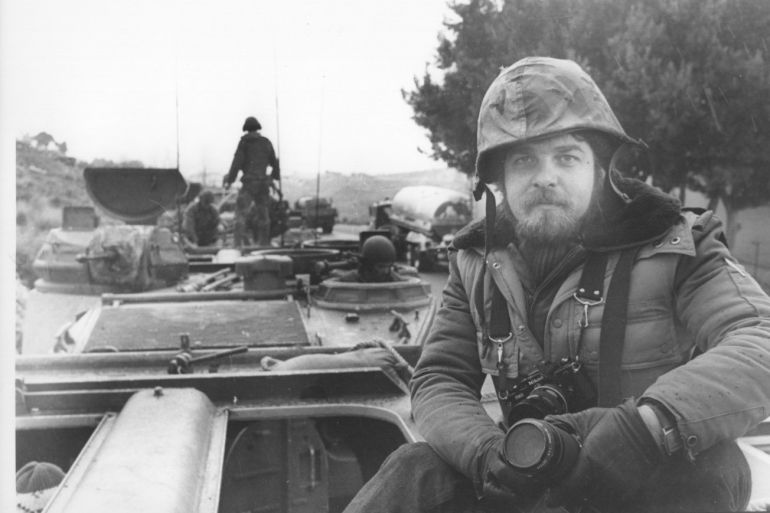
Claude Salhani riding atop an amphibIous landing craft with US Marines in Lebanon, 1983.
Claude Salhani rides on top of an amphibIous landing craft with US marines in Lebanon in 1983. [Courtesy of Claude Salhani's family]
Published On 13 Apr 202513 Apr 2025

On this day in 1975, Claude Salhani was a 23-year-old Lebanese photojournalist working for the Annahar newspaper.

At the time, he dreamed of going to Vietnam and taking the kind of powerful war images he had seen and admired.

However, he wouldn’t have to leave his country to cover war.

On April 13, 1975, the Phalangist militia attacked a bus in Beirut’s Ain el-Remmaneh neighbourhood, kicking off a civil war that lasted 15 years.

The bus was carrying Palestinians and Lebanese home from a political rally by the Popular Front for the Liberation of Palestine – General Command (PFLP-GC).

The Phalangists were responding to a drive-by assassination attempt on their leader, Pierre Gemayel, outside a church. Gemayel was unscathed, but others were killed, including Gemayel’s bodyguard and a Phalangist whose child was being baptised that day.

The lead-up to the Lebanese Civil War was not devoid of other incidents, but Salhani said it was clear something was different after that day.

Over the next nine years, Salhani would capture the brutal reality of the war – Christian and pro-Palestinian militias, the warlords pulling their strings and, most importantly, their victims.

He was threatened by right-wing Christian militias, kidnapped by a Palestinian faction, and wounded by Israeli shelling that broke his ankle and a car crash that left his two front teeth hanging by their roots.

Salhani covered the war for Annahar, the French photo agency Sygma, and the United Press International and Reuters news agencies. His images were featured on the cover of news magazines like Time and Newsweek.

Advertisement

In 1983, he was nominated for a Pulitzer Prize for a photo of a young man dressed in US military fatigues, wiping away a tear after two suicide trucks rammed a barracks and killed more than 240 US military members.

He left Beirut in 1984, hurt by what his home had become. He promised never to return but came back for a visit in 2000 and then returned infrequently until his death.

Salhani died in 2022 in Paris at the age of 70.

He spoke of returning to Lebanon until his final days.

Palestinian combatants maintain their positions in Beirut as they await the results of political negotiations between parties. (Photo by Claude Salhani/Sygma via Getty Images)
Palestinian combatants maintain their position in Beirut on January 1, 1975, as clashes build up to all-out war. [Claude Salhani/Sygma via Getty Images]
Advertisement
New commando recruits undergo intense training in a Popular Front for the Liberation of Palestine (PFLP) camp. The fedayeen live in grottos, cut off from others, and make up one of the toughest organizations of the PFLP. (Photo by Claude Salhani/Sygma via Getty Images)
New commando recruits during their training in a Popular Front for the Liberation of Palestine (PFLP) camp on August 1, 1975. [Claude Salhani/Sygma via Getty Images]
CC
Palestinian nationalist fighters called fedayeen, like this one undergoing training in 1975 at a PFLP camp, lived in grottos, cut off from other people, and were in one of the toughest organisations of the PFLP. [Claude Salhani/Sygma via Getty Images]
Claude Salhani Lebanon
These Cedar Guards as well as Christian and Phalangist fighters took up positions in the Tabet Forest near the Palestinian camp of Tal Zaatar on January 10, 1976, as the civil war between Christians and Muslims, once limited to Beirut and its suburbs, starts to spread across the interior of the country. [Claude Salhani/Sygma via Getty Images]
Claude Salhani Lebanon
Phalangist Christians invade the neighbourhood of Karantina in Beirut on January 19, 1976. Although the inhabitants fled, the Phalangists burned buildings and shops. On the grill of this truck is an image of Libyan leader Muammar Gaddafi, who funded some Palestinian militias. [Claude Salhani/Sygma via Getty Images]
Claude Salhani Lebanon
Salhani was threatened while leaving Karantina, a Muslim enclave of Beirut, by a Phalangist militia leader. He asked his photo agency at the time to publish the photos without his name, but his name was mistakenly added anyway. Salhani wouldn't be able to visit east Beirut for a couple of years. [Claude Salhani/Sygma via Getty Images]
Advertisement
Claude Salhani Lebanon
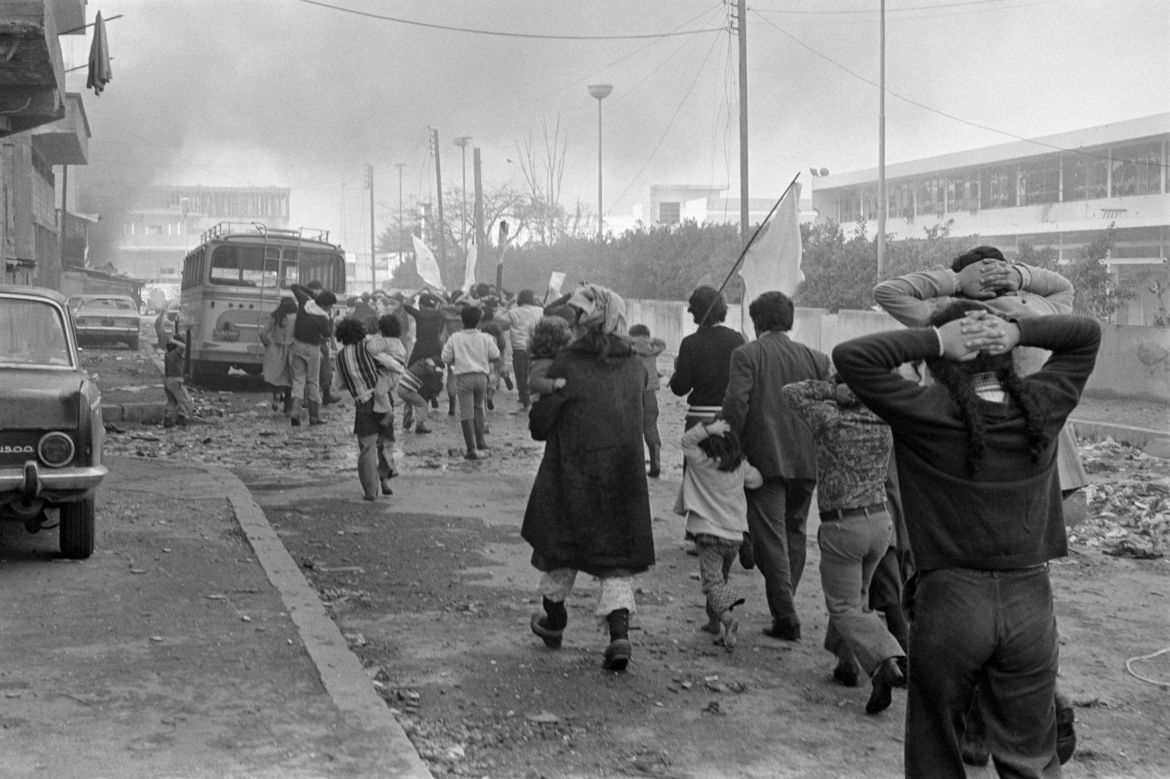
Inhabitants of Karantina line up and leave the neighborhood under the watch of armed Phalangists on January 19, 1976. [Claude Salhani/Sygma via Getty Images]
Claude Salhani Lebanon
In Beirut, fighting continued in spite of a ceasefire. Lebanese militiamen, shown here on June 30, 1976, begin wearing T-shirts with the name of their organisations, some illustrated with representations of fighters. [Claude Salhani/Sygma via Getty Images]
Claude Salhani Lebanon
A woman walks along a street in Karantina, Beirut, during the Phalangist invasion of the Muslim enclave on August 19, 1976. A fighter stands behind her with a gun. [Claude Salhani/Sygma via Getty Images]

Related

  • Israel pushes on with strategy to keep neighbours weak in Lebanon and Syria

    Israel has repeatedly bombed both Syria and Lebanon, experts say it is no mood for peace.

    Published On 9 Apr 20259 Apr 2025
    Israel Syria
  • Unpacking Israel’s war on international humanitarian law

    Israel has tried to legally justify its attacks and treatment of Palestinians, even as it goes against international law

    Published On 10 Apr 202510 Apr 2025
    Palestinians react at the site of an Israeli attack.
  • Will Lebanon’s fragile peace hold after Israel’s strike on Beirut?

    Israel’s first air strike on Beirut since the November truce sparks fears of a wider conflict.

    Published On 1 Apr 20251 Apr 2025
    Beirut bombing
  • Israel strikes Lebanon’s Beirut testing fragile truce with Hezbollah

    Lebanese officials say the attack on Dahiyeh killed at least four people and wounded seven others.

    Published On 1 Apr 20251 Apr 2025
    a damaged building after an Israeli attack in southern Beirut

More from Gallery

  • Photos: Manila’s streets empty as fuel prices surge amid Hormuz crisis

    A sharp increase in prices of basic commodities and the possible loss of employment for thousands of people due to the fuel price hike have raised the spectre of stagflation in the Philippines.
    This gallery article has 10 imagescamera10
  • Photos: More than one million displaced by Israel’s evacuations in Lebanon

    Over one million displaced by Israel’s evacuations in Lebanon
    This gallery article has 10 imagescamera10
  • Migrants march in southern Mexico to denounce immigration restrictions

    Migrants, some carrying children, walk on the highway through the municipality of Huehuetan, Chiapas state, Mexico, Wednesday, March 25, 2026, after leaving Tapachula the previous night. (AP Photo/Edgar H. Clemente)
    This gallery article has 9 imagescamera9
  • Photos: Iran fires new waves of missiles at Israel

    This picture shows damaged buildings at the site of an Iranian missile strike in Tel Aviv
    This gallery article has 8 imagescamera8

Most popular

  • Trump talks up deal with Tehran as Iranian missile, drone attacks continue

    FILE PHOTO: Emergency personnel respond at a site following Iranian missile barrages in central Israel, amid the U.S.-Israel conflict with Iran, in Tel Aviv, Israel, March 24, 2026. REUTERS/Tomer Appelbaum ISRAEL OUT. NO COMMERCIAL OR EDITORIAL SALES IN ISRAEL/File Photo
  • Iran war updates: US, Israel attack ignites worst trade rupture in 80 years

    This handout image taken by the European Space Agency (ESA) captured by the Copernicus Sentinel-2 satellite shows a view of smoke plumes billowing in the vicinity Kuwait International Airport on March 25, 2026.
  • Tehran’s ‘toll booth’: How Iran picks who to let through Strait of Hormuz

    The Callisto tanker sits anchored in Port Sultan Qaboos as the traffic is down in the Strait of Hormuz
  • Trump’s signature to appear on US currency in first for sitting president

    Trump

  • About

    • About Us
    • Code of Ethics
    • Terms and Conditions
    • EU/EEA Regulatory Notice
    • Privacy Policy
    • Cookie Policy
    • Cookie Preferences
    • Accessibility Statement
    • Sitemap
    • Work for us
  • Connect

    • Contact Us
    • User Accounts Help
    • Advertise with us
    • Stay Connected
    • Newsletters
    • Channel Finder
    • TV Schedule
    • Podcasts
    • Submit a Tip
    • Paid Partner Content
  • Our Channels

    • Al Jazeera Arabic
    • Al Jazeera English
    • Al Jazeera Investigative Unit
    • Al Jazeera Mubasher
    • Al Jazeera Documentary
    • Al Jazeera Balkans
    • AJ+
  • Our Network

    • Al Jazeera Centre for Studies
    • Al Jazeera Media Institute
    • Learn Arabic
    • Al Jazeera Centre for Public Liberties & Human Rights
    • Al Jazeera Forum
    • Al Jazeera Hotel Partners

Follow Al Jazeera English:

  • facebook
  • twitter
  • youtube
  • instagram-colored-outline
  • rss
Al Jazeera Media Network logo
© 2026 Al Jazeera Media Network